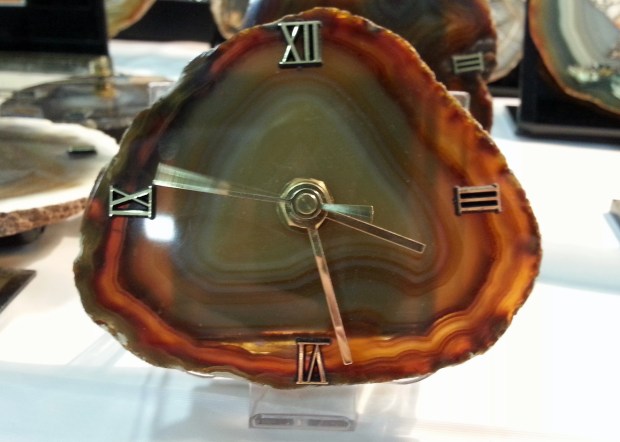
Agate slab clock, seen at the Fall Gem and Mineral Show 2016. Photo by Stephanie Reed
We hope you are having fun at the show. Don’t forget to set your clocks forward 1 hour for Daylight Savings Time.
Agate slab clock, seen at the Fall Gem and Mineral Show 2016. Photo by Stephanie Reed
We hope you are having fun at the show. Don’t forget to set your clocks forward 1 hour for Daylight Savings Time.
Lectures presented by the Association of Earth Science Clubs of Greater Kansas City
Friday, March 10, 2017
3:00 p.m. “Opal Down Under”, Ron Wooly, Owner of Dreaming Down Under
Saturday, March 11, 2017
1:00 p.m. “Earth Science… Facts, Frauds and Scams”, Mark Sherwood, Independence Gem and Mineral Society
2:00 p.m. “The Life and Hard Times of the KU T. rex”, Dr. David Burnham, Research Associate, University of Kansas, Lawrence, Kansas
3:00 p.m. “Medullary bone in Tyrannosaurs: a question of chickens, eggs and possibly more”, Dr. Josh Schmerge, University of Kansas, Lawrence, Kansas
4:00 p.m. “History of Gold Mining”, Doug Foster, Show-Me Gold, Missouri
Sunday, March 12, 2017
2:00 p.m. “The Life and Hard Times of the KU T-rex”, Dr. David Burnham, Research Associate, University of Kansas, Lawrence, Kansas
3:00 p.m. “Islands in the sun: Eocene fossil mammals from Turkey”, Dr. Chris Beard, University of Kansas, Lawrence, Kansas
The Association has a scholarship for students studying earth science. The value will be between $250 – $1000. To apply, fill out this form on the Association website here and mail it to Molly Stinemetz. The application says 2015 but it is good for 2017. The scholarship happens every year.
Deadline: February 28, 2017
Requirements:
When you come to the show, don’t forget to enter the drawings for door prizes.
Kids’ Drawing:
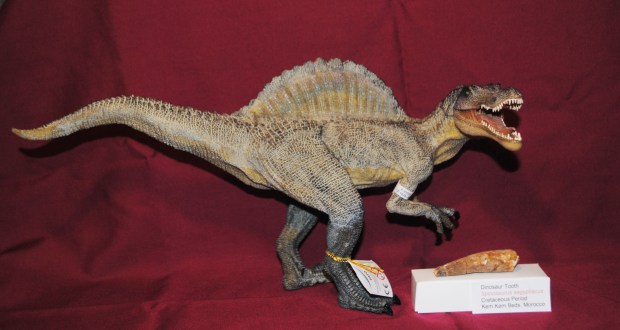
Dinosaur Model with Real Tooth
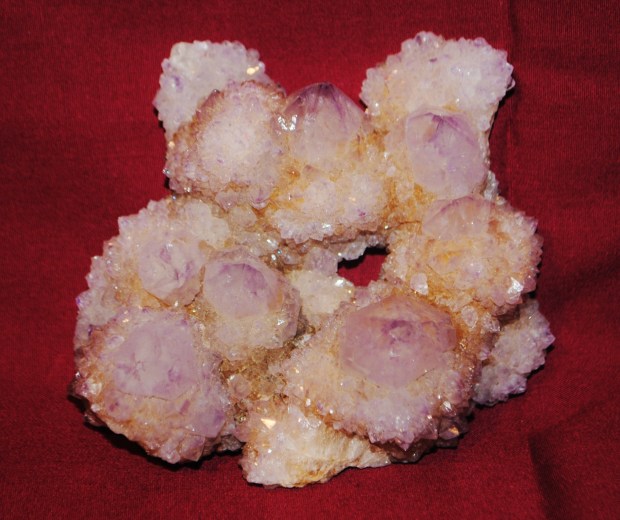
Cactus Quartz
KANSAS CITY GEM SHOW SPRING 2017 FEATURE EXHIBIT
ROCK ART –Stone Quilt Design; Susan Judy; Denver, CO and WKP Accent Tables; Bill Peterson; Boulder, CO
Colorado artists Judy and Bill have brought some of their creations to the Kansas City Show. Judy inlays natural materials in a stone mosaic to create pictures and Bill uses natural materials to create tables.
INVITATIONAL EXHIBITS (more…)
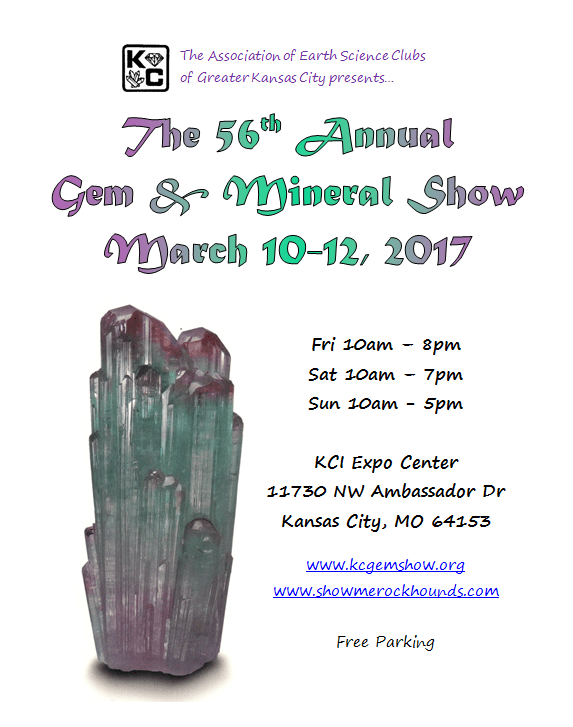
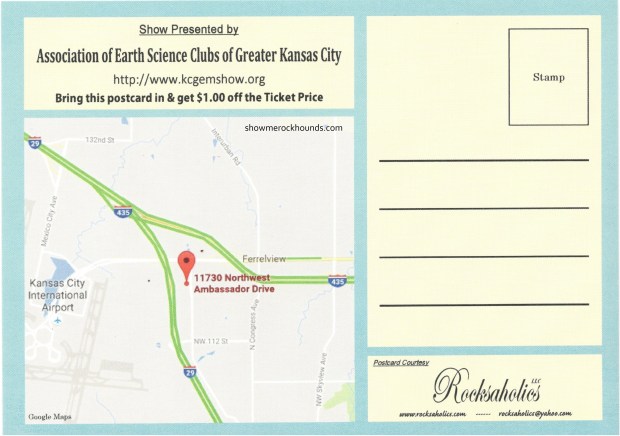
Mark your calendar for the Spring 2017 Gem and Mineral Show, sponsored by the Association. Here is a flyer in PDF format you can print or send to all your friends, and a coupon for $1 off admission.
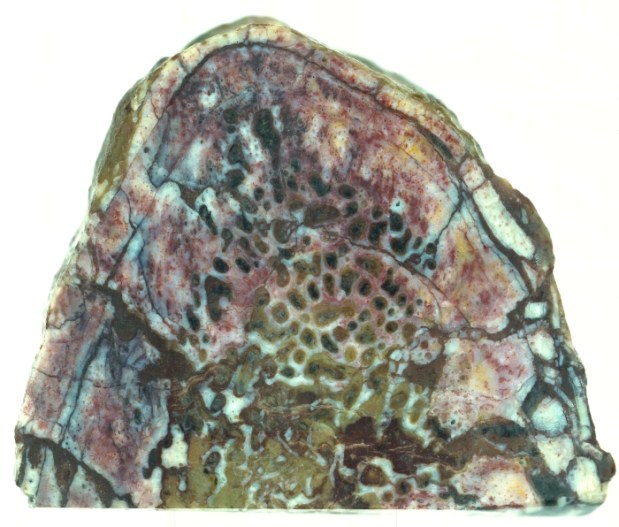
Paleontologists at the University of Toronto just found collagen in a 195 million year old fossil. This makes it the oldest protein that has ever been found. Previously, the oldest protein sample was only 80 million years old (it was also collagen, from a dinosaur bone). They also found hematite crystals in the fossil, which possibly came from the blood. The dinosaur was a Lufengosaurus that lived in Yunnan Province, China.
Some other paleontologists didn’t like the new, non-invasive methods that the team used used to identify the collagen, but other scientists thought the methods were fine. Read the whole article here https://cen.acs.org/articles/95/i6/Collagen-found-195-million-year.html and let me know what you think.

Rooster Rock, Crown Point, and the Vista House (top right, on top of Crown Point). Photo by Lyn Topinka, http://columbiariverimages.com/Regions/Places/rooster_rock.html

Photo by Thomas Kuo, from Google Maps. This is Crown Point and the Vista House seen close up from the other side.
Celebrate the new Year of the Rooster by going to Rooster Rock State Park in Portland, Oregon. Rooster Rock is a large basalt feature located on the Oregon side of the Columbia River at River Mile (RM) 129, just below the base of Crown Point. It is also called Woutoulat or Crow’s Roost, sometimes. There is a Vista House on top of the Crown Point, which is a lava flow. The state park has many amenities including: a boat ramp into the Columbia River, fishing, swimming, windsurfing, hiking, ADA accessible picnic shelters, parking lots, restrooms, two disc golf courses, and a clothing-optional beach. Also, Lewis and Clark camped there on November 2, 1805.
Sources: http://columbiariverimages.com/Regions/Places/rooster_rock.html http://oregonstateparks.org/index.cfm?do=parkPage.dsp_parkPage&parkId=126
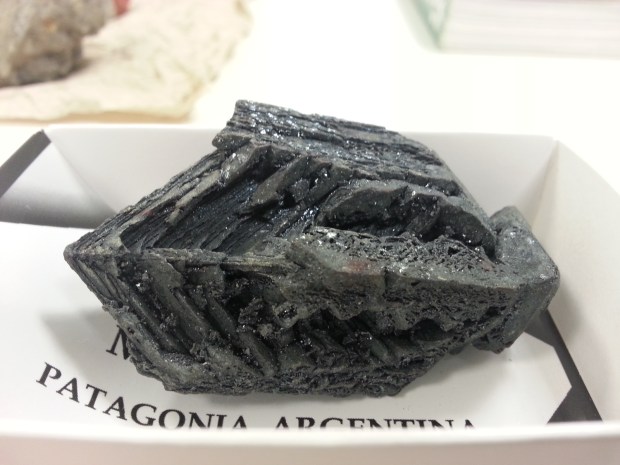
Photo by Stephanie Reed
This hematite and magnetite specimen is from Patagonia, Argentina. Bruce got it at the Denver show and gave it to Sharon Penner. It’s about 4 inches long and pretty shiny.
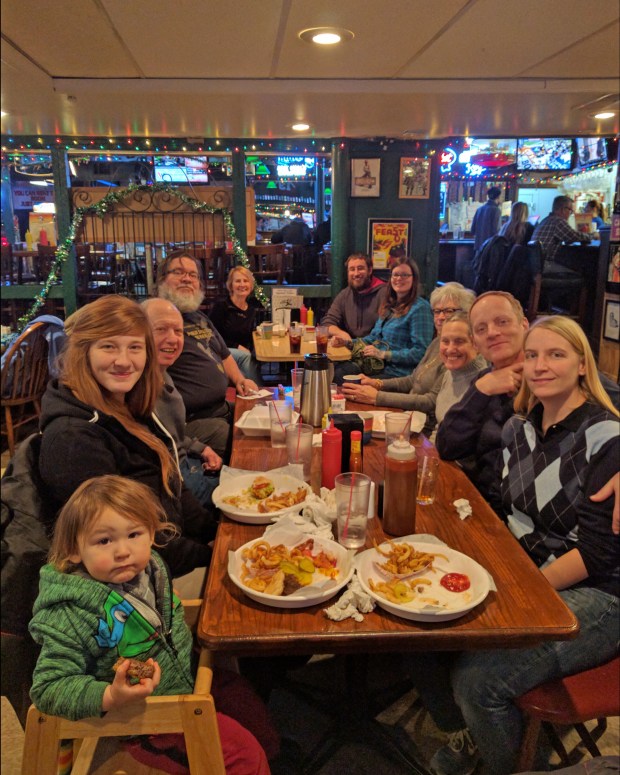
Group picture
We braved the snow and had a great time at the Westport Flea Market. After lunch, we had a mystery gift exchange which contained several rocks, a rock painting kit, jewelry, a book about rocks, and much more. See you in January!
 Show-Me Rockhounds Kansas City