Minerals

Scepter Quartz

Article by Amir Chossrow Akhavan, http://www.quartzpage.de/gro_text.html

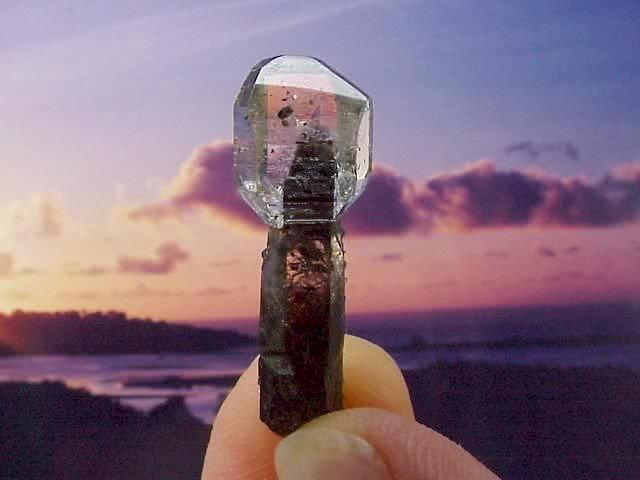
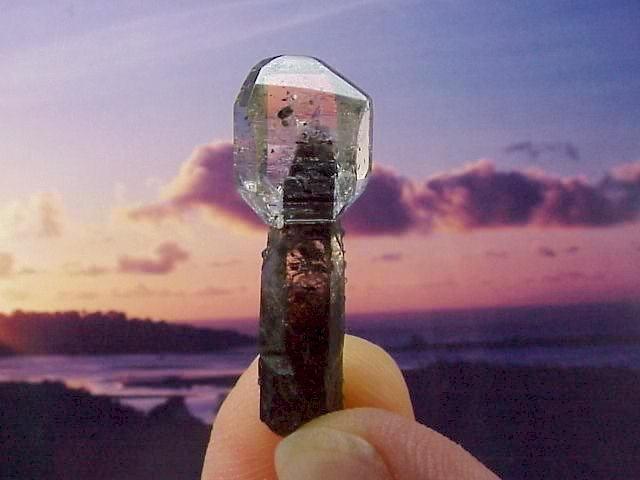
A scepter quartz is often defined as a quartz crystal that has a second generation crystal tip sitting on top of an older first generation crystal. The second generation tip typically becomes larger than the first generation tip, but might also become smaller. A scepter can be shifted sideways and does not need to be centered on the first generation tip.
However, there is a problem with a definition that is based on the idea of a second generation: scepters do not only occur as a second generation on an older crystal, they also form stacks of parallel grown crystals that developed at the same time, very often as skeleton quartz. Another difficult case are reverse scepters in which the scepter is smaller than the underlying tip. Here the smaller tip very often does not show any properties that clearly distinguish it from the rest of the crystal and that would justify calling it a second generation. Instead, the crystals often appear to have grown continuously into the reverse scepter or multiple scepter shape.

In all cases, the scepter develops from the already present crystal lattice of the crystal underneath. Thus, to be a scepter quartz, the “second generation” crystal’s a- and c-axes need to be oriented parallel to the respective axes of the “first generation” crystal; just one crystal on top of another doesn’t make it a scepter. Such a crystallographically well defined intergrowth of different minerals is called an epitaxy. In a sense, a scepter represents an epitaxy of quartz on quartz, and because it is the same mineral, it is sometimes called an autotaxy.

Scepters are quite common in certain geological environments. Amethyst from alpine-type fissures in igneous and highly metamorphosed rocks usually occurs as scepters on top of colorless or smoky crystals (not only in the Alps, but for example also in southern Norway or northern Greece). Here, the amethyst generation grew at lower temperatures than the first generation quartz. The same growth form can be observed in pegmatites and miaroles in igneous rocks (for example, amethyst scepters from the Brandberg, Namibia, or from pegmatites in Minas Gerais, Brazil).

Scepters, or to be precise, the “second generation” part of a scepter quartz that defines it, commonly have a number of morphological properties:

  • Scepters are commonly of normal habit and are never tapered. The underlying “first generation” crystal may show a Tessin habit, but the scepter on it will not.
  • Scepters tend to assume a short prismatic habit. An apparent exception are reverse scepters and the normal scepters associated with them, which may occur as elongated extensions of a “first generation” crystal, but then in the shape of multiple stacked scepters.
  • Many scepters show only a weak striation on their prism faces, sometimes it is even missing.
  • Scepters do not show split growth patterns.
  • Scepters rarely show trigonal habits with very small or missing z-faces. An exception are reverse scepters and the normal scepters associated with them.
  • Scepters are often associated with skeleton growth forms (skeleton or window quartz).
  • Scepters commonly show a color, color distribution, diapheny and surface pattern that is markedly different from the underlying “first generation” crystal. Often they are more colorful and transparent. Amethyst scepters are very common, smoky quartz scepters -often with uneven color distribution- are common. An exception are reverse scepters and the normal scepters associated with them which seem to either not differ from the “first generation” or show gradual transitions.
  • Summarizing the exceptions above: Reverse scepters and the normal scepters associated with them seem to have a different set of properties.

Formation

One theory is that a scepter forms when crystal growth is interrupted and parts of the crystal are covered with some material that inhibits further growth. The growth inhibiting material might be only present as a very thin layer and invisible. The very tip of the crystal or the entire rhombohedral faces remain free of that material, and should the conditions change again, the crystal continues to grow from the tip.

One of the problems with that theory is that you would expect to see a larger number of “double”, “triple” or “quadruple scepters”, specimen in which the growth had been interrupted several times and in which scepters with slowly changing habits are stacked. In nature, however, you see a strong dominance of “simple” scepters that consist of just a prism with “a single head”. If you see multiple scepters, then often alongside simple scepters, although multiple changes in the environment should have affected the morphology of all of them equally.

Another problem is that you would not expect to see a fully-grown scepter that encloses the former tip like an onion if the crystal simply started growing from a single point on the surface of the tip. Such a crystal would finally grow into an elongated crystal and would at best assume the shape of a reverse scepter.

As I’ve mentioned, amethyst from igneous and metamorphic rock locations all over the world predominantly occurs as scepters. Even if you just take Alpine locations, it is hard to imagine that the environmental conditions in all those locations have undergone a single sudden change that led to a temporary growth inhibition on the crystals, followed by a very distinctive growth pattern, the formation of scepters.

The internal structure of scepters from Alpine-type fissures (and of scepters in general) is perhaps always lamellar, as opposed to the macromosaic structure of many quartz crystals from Alpine-type fissures. Quartz crystals with a macromosaic structure may carry a scepter, but the scepter will then show lamellar structure.

Fossil Sweet Gum

A big slab of petrified wood that is green

Photo by Stephanie Reed

This is a cross-section of a fossilized sweet gum tree from the Hampton Butte in Crook County, Oregon. We saw it at the Rice Museum in Hillsboro, Oregon where it is in the petrified wood room. I hardly ever see petrified wood that is green like this; usually it’s red, orange, or brown. Anybody know what makes it green?

Corundum

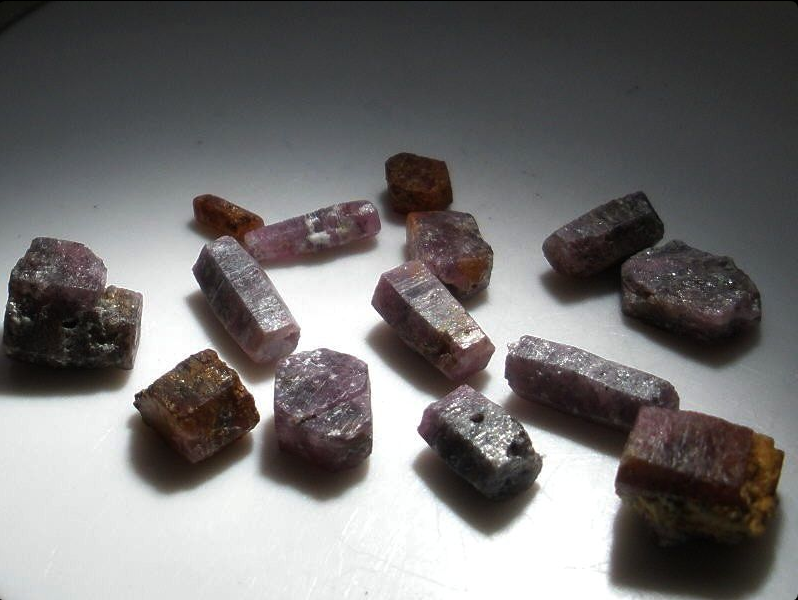
Corundum (Al2O3) is a hematite group mineral that has trigonal crystals. It is found all over the world and can be many different colors including blue, red, pink, yellow, gray, and colorless. These corundum crystals are from the Cascade Canyon in San Bernadino, California. They may not look familiar to you, but corundum has some famous relatives. A gem-quality corundum that is red (Cr-bearing) is known as ruby, and a gem-quality corundum that is blue (Fe- and Ti-bearing) is known as sapphire.

Wisconsin Moonstone

When you think of rockhounding in Wisconsin, you probably think of Lake Superior agates. But did you know that Wisconsin also has moonstone? Read this article from the MWF January 2015 newsletter to find out more.

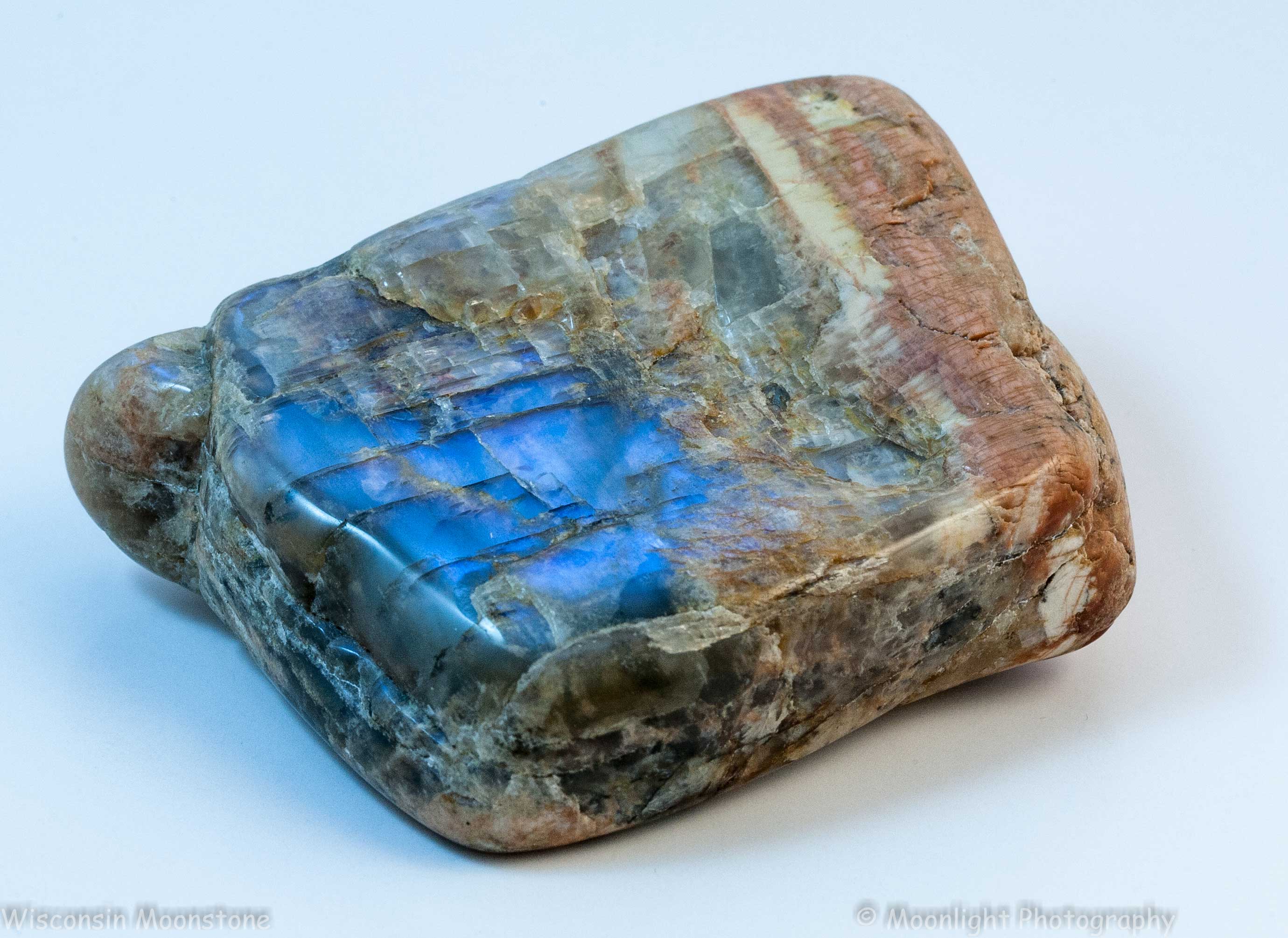
Anorthoclase moonstone from Wisconsin.

Image from Bill Schoenfuss and Moonlight photography.

WISCONSIN’S MOONSTONE

by Dr. William S. Cordua

Emeritus professor of Geology

University of Wisconsin – River Falls

Imagine an October full moon in Wisconsin glowing ghostly blue to yellow as it seems to float over the newly harvested farm fields. Or is this captured in the rock? In Wisconsin’s own moonstone?

Wisconsin moonstone has been known for decades, but only recently have skilled lapidarists learned to work it to bring out its full beauty. This find surprises non-residents, who at generally associate Wisconsin gemstones with Lake Superior agates and nothing else. What is this material? How did it form? What causes its optical effect?

The moonstone localities are on private land in central Wisconsin, not far from Wausau in Marathon County. The mineral is a type of feldspar known as anorthoclase. This formed as a rock-forming mineral within the Wausau Igneous Complex, a series of plutons intruded between 1.52-1.48 billion years ago. There are at least 4 major intrusive pulses within the complex.

The anorthoclase is in the Stettin pluton, the earliest, least silicic and most alkalic of the plutons of the Wausau complex. This body is complexly zoned, largely circular in outcrop and has a diameter of about 4 miles. It is mostly made of syenite, an igneous rock resembling granite, but lower in silica and higher in alkali elements such as potassium and sodium. As such, it lacks quartz, but does contain a lot of alkali feldspar. Further complicating the geology is the intrusion of later pegmatite dikes. Some especially silica-poor varieties sport such odd minerals as nepheline, sodalite, fayalite, and sodium rich amphiboles and pyroxenes. Zircon, thorium, and various rare earth element minerals can be found in this pluton. Large prismatic crystals of arfvedsonite and nice green radiating groups of aegirine (acmite) crystals have been collected for years from these rocks. It is also the pegmatite dikes that contain the anorthoclase showing the moonstone effect.

The moonstone has been found in small pits and quarries and also in farm fields where masses weather out and get frost-heaved to the surface. The weathered masses of coarse cleavable feldspar may at first not look too interesting, but at the right angle the moonstone effect can be seen. The feldspar has two change and bounding capacity, so fit readily in the same niches in the feldspar. But sodium and potassium aren’t enough alike. If the feldspar cools down slowly, to below 400 degrees C, the feldspar structure contracts in size, and sodium and potassium are no longer good interchangeable fits. The homogenous anorthoclase splits on a fine scale into intergrown potassium feldspar and albite. Sometimes the bands of alternating minerals are coarse enough to see. Other times they are microscopic. If they are just the right size and spacing, they scatter the light that penetrates the various layers in the mineral – producing the moonstone effect, or schiller. The only anorthoclase that is truly not a mixture is that which cools very rapidly, such as in lava flows, so the separation cannot occur, and the mineral is frozen into its high temperature form. The material at Wausau cooled slowly, so isn’t, strictly speaking, anorthoclase anymore, but an exsolved mixture.

The crystalline structure controls the orientation of these exsolution bands, hence the effect is seen better on some surfaces (the {010} cleavage for example) than at others. This is one reason why shaping the rough stone takes such skill. Other challenges are the weathered nature of some of the stone, and exploiting the cleavage directions inherent in the feldspar.

Polished moonstone fragment several centimeters long showing the moonstone effect.

Image from Bill Schoenfuss and Moonlight photography.

The master of processing these stones is Bill Schoenfuss of Wausau, Wisconsin. Bill often exhibits and sells his beautifully prepared moonstone at shows in the upper midwest. He can be contacted at schoenfuss

Moonstone has been prized as a gem since antiquity, often characterized as being like solidified moonbeams. The Greeks and Romans both related the gem to their moon gods and goddesses. The American Gem Society considers moonstone an alternate birthstone for June.

Mineral Nail Polish

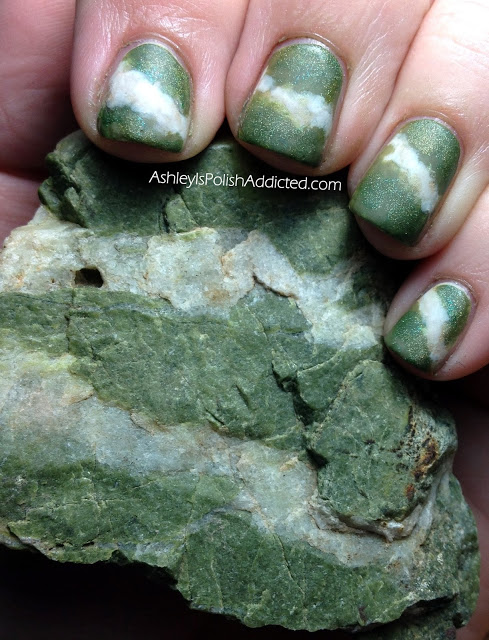
There are a lot of ways to express your love for rocks, whether you have a display case in your home, a collection of geology maps and field guides, you go to gem and mineral shows, or even bake a rock cake.  Ashley has a passion for nail polish and had a rock collection as a child, so she combined the two by painting her nails to look like this specimen of quartz and green shale. I love the way she used multiple shades of green and white to perfectly recreate the color of the shale and make the “quartz” part of her fingernails look translucent. Go to her blog post to find out the specific kinds of nail polish she used.

Emeralds

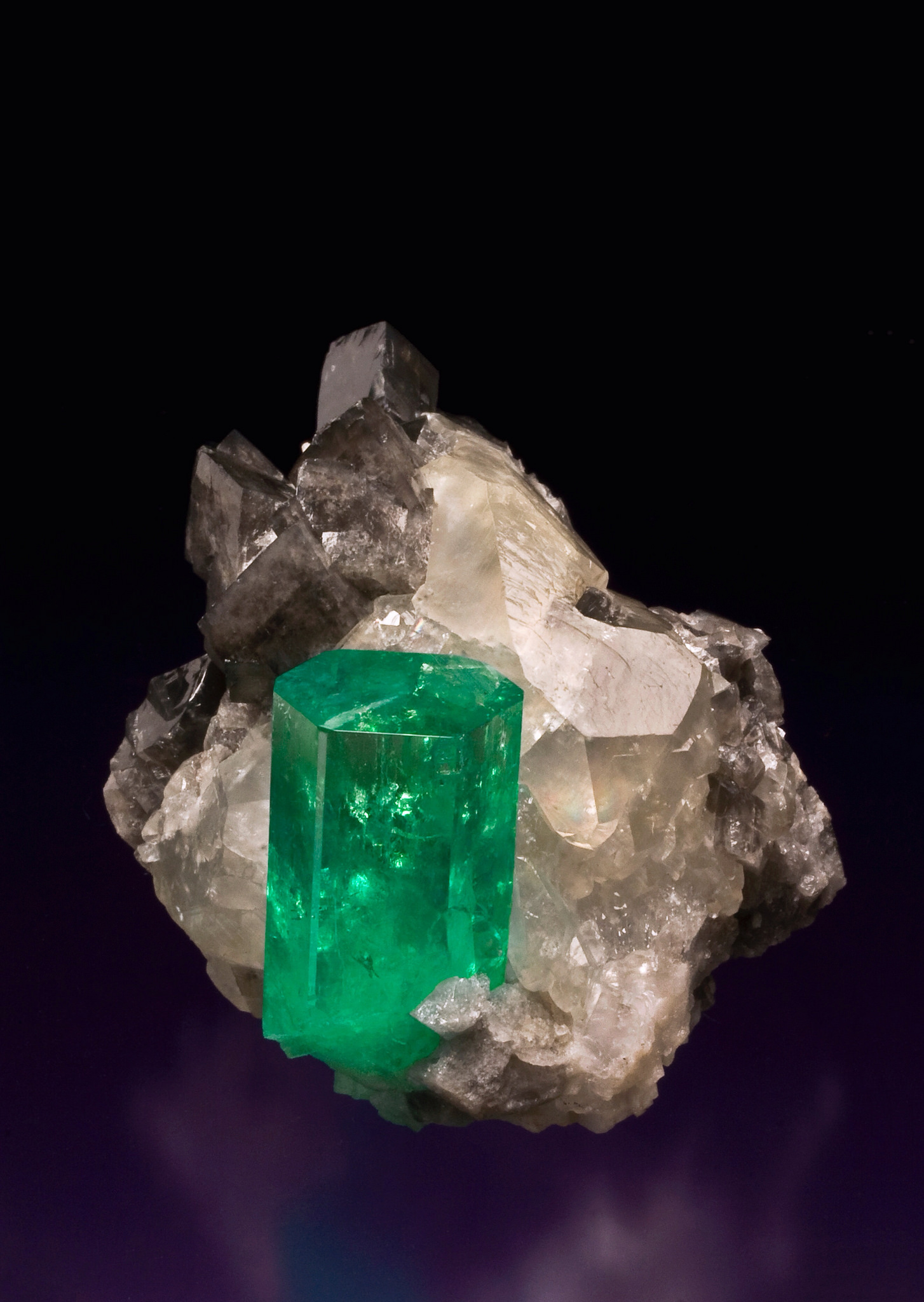
Emeralds are the most famous green gemstone. The word emerald is practically synonymous with the color green, and in fact, the name emerald comes from the Greek smaragdos which means “green gem.” Ireland’s nickname “The Emerald Isle” sadly does not refer to any emeralds found there but for the green scenery.

Emeralds are the green variety of the mineral beryl. The famed green color comes from chromium impurities. When beryl appears in other colors due to different impurities it is called aquamarine (blue), morganite (pink), bixbite/red beryl (red), or heliodor (yellow). Emerald rates 7.5-8.0 on the Mohs hardness scale, though it can be brittle. Emeralds are usually found in Colombia (South America) or Zambia (Africa) in granite pegmatites and metamorphosed mica schists. They grow in hexagonal crystals. The most valuable emeralds for gems are transparent rather than opaque, have few inclusions, and are a dark shade of green. Emeralds usually have quite a lot of inclusions, so sometimes people use oil to hide them, but looking at the inclusions can help you tell where the emerald came from. One final fun fact: There is even a faceting method called the emerald cut, which has a rectangular face with 8 sides. It is also known as the octagon cut. The emerald cut works well on emeralds but can be used on any gemstone, even diamonds.

The Blarney Stone

I don’t know about you, but I’m still in the St. Patrick’s Day spirit. This is the Blarney Stone, the most well-known rock in Ireland. The Blarney Stone is embedded 90 feet high in a tower of Blarney Castle, in the village of Blarney near Cork, Ireland. Legend has it that if you kiss the stone you will receive the skills of eloquence, persuasion, and flattery: in other words, blarney. Climb to the top of the tower, sit with your back to the stone, then have someone hold your legs down while you lean backwards to kiss the stone.

The Blarney Stone itself is carboniferous limestone, also known as bluestone. Geologists at Glasgow University analyzed a sample of the stone and determined that it is “limestone, made of the mineral calcite, and containing recrystallised and slightly deformed fragments of fossil brachiopod shells and bryozoans – all of which are unique to the region where it is based” (www.theguardian.com/world/2014/mar/16/mystery-blarney-stone-heritage-solved) Some stories suggest that the Blarney Stone was from Scotland, but this research shows that it is native to Ireland and is about 330 million years old. Erin go bragh!