April Field Trip Polls

As you may know, we are having a field trip to Marquette, KS in April. We need to get some feedback to plan the trip. Please answer these 3 polls below.

We are considering staying overnight and also visiting Lake Kanopolis and Lake Wilson.

How shall we get there?

If you want to go on this field trip but you are not yet a member of the club, bring $5 for your membership fee and you can join during the trip.

Spring Forward to the Show

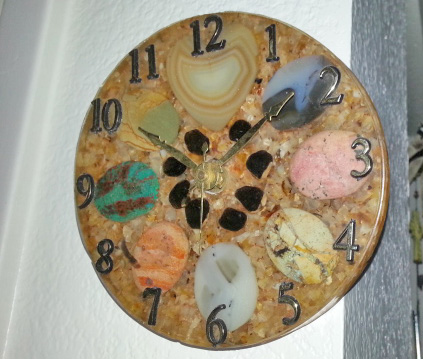
mineral clock with agates and apache tears

Photo by Stephanie Reed

We interrupt the Spring Gem and Mineral Show to remind you to set your clock forward one hour tonight for Daylight Savings Time.

This clock is from the collection of David Reed. It contains agates, Apache tears (obsidian), a craft store clock kit, and lots of resin. It looks pretty good with his other rock clock.

Dyed Agates

Have you ever seen dyed agates and wondered how they get such brilliant colors? The process is more simple than you might think. A company buys banded agates in bulk and soaks the slabs in certain chemicals for a certain amount of time (in a fume hood of course). Heat treating may also be required.

But how do they preserve the white stripes that make the agates look like agates? This is simply because some bands are porous and will absorb the dye, but the denser layers and the quartz crystals will remain white because they are too dense to absorb the dye.

(Note: To discourage you from trying this at home, I’m not going to specify the concentrations.)

Red: Iron (II) nitrate for several weeks folllowed by heating to 300° C
Green: Potassium chromate followed by ammonium carbonate plus heating to 440° C
Blue: Potassium ferrocyanide followed by ferrous sulfate
Black: soak in sugar for 3 weeks followed by sulfuric acid for 3 weeks

How To Clean Rocks

Household Products That Can Be Used As Rock Cleaners

by Betsy Martin
Safety: Always use plastic containers, rubber or nitrile gloves, eye protection, good ventilation, and great care when handling these products.
1. Zud or Barkeeper’s Friend cleansers (contains oxalic acid) – Warm or hot solutions will remove iron stains and are helpful with clay deposits. These cleaners can be used with a toothbrush on sturdy surfaces.
2. Toilet Cleaner (the hydrochloric acid type) dissolves calcite rapidly. After treating anything with an acid, rinse very carefully and soak in ample fresh or distilled water for a while to leach out any acid remaining in crystal seams and fractures. You can then follow up with a final soak in dilute Windex to neutralize remaining traces of acid.
3. Lime Away (dilute hydrochloric acid) dissolves calcite more slowly. Rinse as you would for other acid treatments (see above).
4. Calgon – Dissolve this powdered water softener in water. Use for clay removal.
5. Vinegar (Acetic acid), soda water, colas (carbonic and phosphoric acids) – Will slowly etch out very delicate fossils in limestone. Rinse as you would for other acids (see above)
6. Iron Out (iron stain and clay remover) – Mix with warm water and use with good ventilation. It will lose strength if stored. Rinse with plain water.
7. Bleach – Dilute solutions of bleach can remove organic deposits and disinfect minerals collected in areas used by livestock. Rinse with plain water.
8. Hydrogen peroxide – Use to remove manganese stains. Rinse with plain water.
9. Citric acid – Use to remove manganese stains. Rinse as above for acids.
10. Windex (with ammonia) – A good clay deposit remover and final surface cleanup. Works well in ultrasonic cleaners. Rinse with plain water.
11. Distilled Water – Use to clean sensitive species and as a final soak after acid treatment.

Removing Thin Coatings:
On moderately hard minerals – use toothpaste (a feldspar abrasive) and a toothbrush.
On hard minerals – use toothbrush with pumice powder and water.
On calcite (including bruised places) – quickly dip in vinegar or Lime Away and rinse thoroughly. Repeat. Soak in plain water afterwards to leach any acid from cracks.

The following tools can be used for cleaning minerals and tools:
Toothpicks, seam ripper, bamboo sticks, sewing needles in a pin vise, old dental tools, old toothbrushes, periodontal brushes, canned air, Exacto knife, single edge razor blades, cheap small stiff bristle brushes.
Source: The Gemrock, 06/2015
Pyrope Garnet

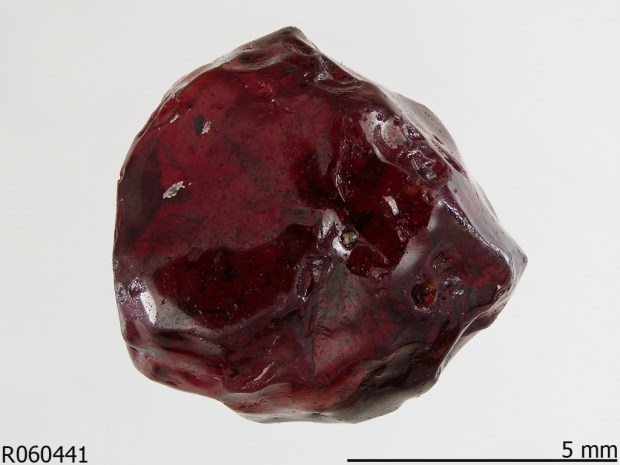
This is a special type of garnet called pyrope garnet. The name comes from the Greek pyro, meaning fire. Pyrope and other members of the aluminum part of the garnet group have a higher specific gravity and hardness, and are usually red. Calcium garnets like the previously mentioned andradite and uvarovite are the ones that are usually green and have a lower hardness and specific gravity.

Pyrope garnet is difficult to distinguish from almandine, but pyrope usually has fewer flaws and inclusions. However, garnet jewelry is usually almandine garnet because almandine is much more common and inexpensive.

If you would like some pyrope garnet it can be found nearby in Kansas, all around the Nemaha Uplift (or Nemaha Ridge), which is in the area between Salina and Manhattan, and extending south into Oklahoma. Basically, garnets are found anywhere near previous volcanic activity. The one pictured is from Apache County, Arizona. They are also found in Africa and other places. For lots and lots of information about this particular specimen, see its page on the RRUFF here.

Andradite Garnet

andradite garnet

Credit: Aaron Palke/Gemological Institute of America

Since it’s January, it’s a good time to read about this garnet originally posted by Chemistry in Pictures.

“This gemstone isn’t pure andradite garnet [Ca₃Fe₂(SiO₄)₃], but its flaws produce its mesmerizing colors. Some gemologists think that this rainbow explosion arises because the garnet’s different elements aren’t regularly spaced from the core of the gemstone to the outside. For example, in some regions, aluminum atoms might have worked their way into the structure and replaced the iron atoms. These irregularities create mismatched sheets of atoms that then bend and stretch. This makes the stone birefringent, meaning that light travels through it at two different speeds. Under cross-polarized lighting conditions, rays of light that enter get misaligned by the time they exit, so they then interfere with each other and highlight some colors in certain spots, producing the spectrum seen here. The black flecks are tiny pieces of magnetite that were enveloped by the crystal as it grew.”

Composita

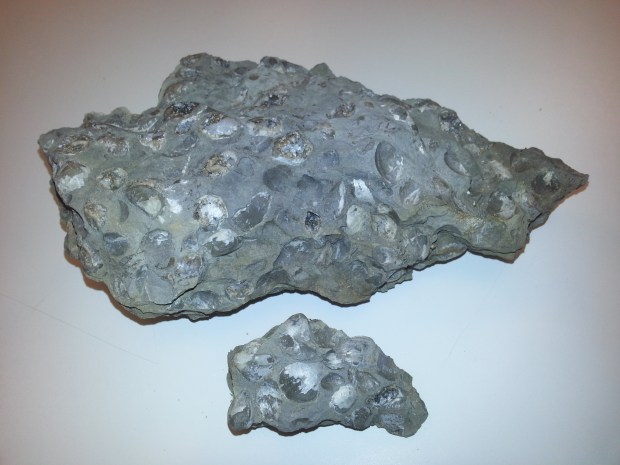
Lots of Composita shell fossils found in Kansas City

Photo by Stephanie Reed

If you came to our January meeting, you will know that we are now offering door prizes just like at IGAMS. All my spying on IGAMS meetings is proving to be very helpful! January’s door prize was part of Kansas City’s Composita layer. Composita is a genus of extinct brachiopods that were abundant during the Pennsylvanian era. Brachiopods are bottom-dwelling marine organisms that have two shells[1] and a little fleshy “foot” called a pedicle. In a fossil brachiopod, you can see the hole where the pedicle sticks out of the shell, which is called the pedicle valve. In the upper part of the Winterset Limestone in Kansas City, there is a zone consisting almost entirely of Composita shells. See Chapter 11 of Dr. Gentile’s book for more information. Some of the shells in this specimen even had crystals inside. It was collected by David Reed somewhere in the Kansas City area, but he’s not telling exactly where.

[1]Brachiopods have two shells, but they are not bivalves (an easy mistake to make). Bivalves are a class of mollusks, like clams, and do not have pedicles. Bivalves are symmetrical, and brachiopods are not. In fact, the bivalves may have caused the extinction of the brachiopods due to competition for food and living space.

A Great Geology Book

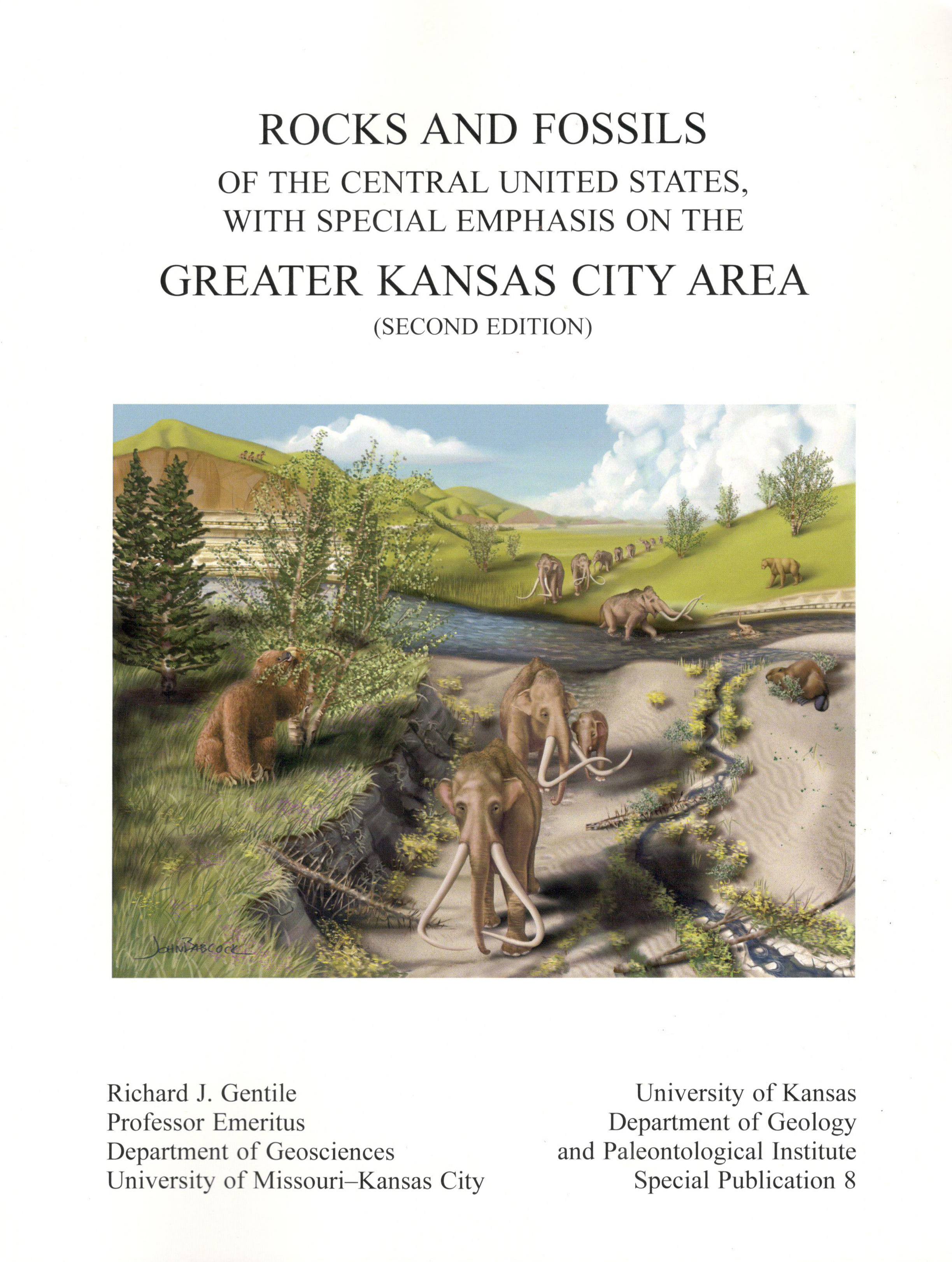
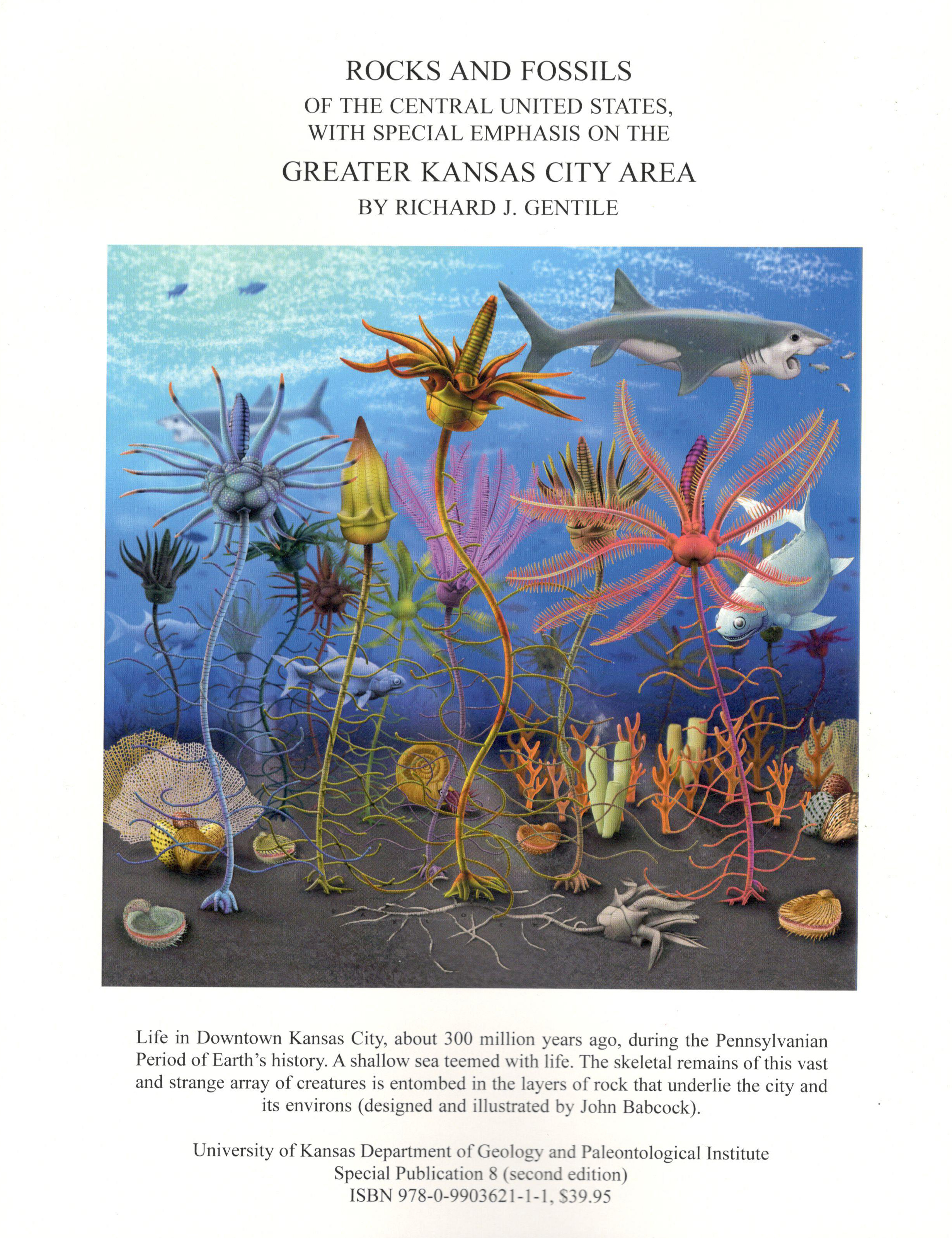
Rocks and Fossils of the Central United States with Special Emphasis on the Greater Kansas City Area by Richard Gentile

The front cover of Richard Gentile's book, Rocks and Fossils of the Central United States with Special Emphasis on the Greater Kansas City Area

Front cover

The back cover of Richard Gentile's book, Rocks and Fossils of the Central United States with Special Emphasis on the Greater Kansas City Area

Back cover

Review by David Reed:

This book is great! It has beautiful pictures of the fossils that can be found in Kansas City and clear stratographic sections explaining the geology of the area. It also shows locations for picking up the fossils. Everything you might wish to know about Kansas City is in this book. Well worth the money and you can ONLY get it at UMKC (Amazon doesn’t have it). We purchased one when we visited the Sutton Museum.

Anthracite

Q: What makes rockhounds different from non-rockhounds?

A: They are happy to receive coal for Christmas.

Rockhounds love coal, and they love anthracite even more. Anthracite is a type of coal. It is very hard and burns slowly and cleanly due to its high carbon content and few impurities. It is rarer than bituminous coal (the soft, most common form of coal); in fact, less than 2% of the coal in the United States is anthracite. Also unlike bituminous coal, anthracite won’t leave soot on your fingers when you touch it.

There are four types of coal in all. The last two we haven’t covered yet are lignite coal and subbituminous coal, which have the lowest carbon content and are even softer then bituminous coal. Anthracite is the hardest and has the highest carbon content. Most of the coal in the United States is found in Colorado and Illinois, and is used primarily for making electricity and coke (coke is used by foundries to make iron and steel).