Rutile quartz

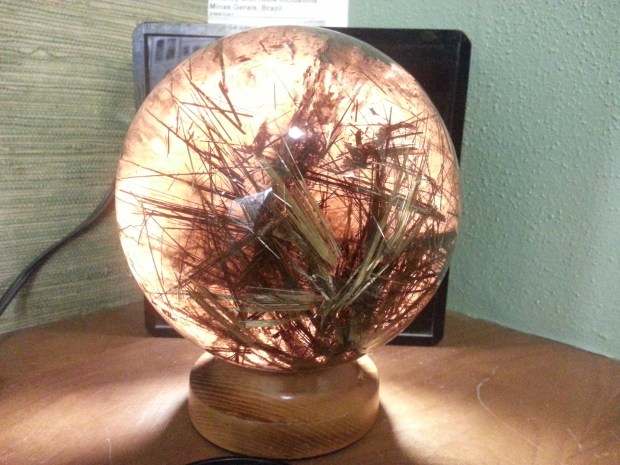
A glowing orange sphere with long dark spines (rutiles) trapped within. They look like tufts of fur.

Photo by Stephanie Reed

Rutile quartz is quartz that contains rutile inclusions. Rutile is made of titanium dioxide and usually forms long, thin needles. It is most commonly found in quartz, though it can also be found in sapphires. The inclusions are usually gold in color and can be seen in dense parallel fibers or as scattered needles. You can see both in this specimen.

This rutilated quartz sphere is smoky quartz with rutile inclusions from Minas Gerais, Brazil. It is on display at the Rice Museum in Hillsboro, Oregon near Portland, Oregon. If you are in the area, we highly recommend this museum.

How Amethyst Cathedrals are Formed

purple amethyst cathedral in a museum with other minerals

Amethyst cathedral at the Sutton Museum. Photo by Stephanie Reed

Article by Dr. Bill Cordua, University of Wisconsin-River Falls

Have you ever been to a show and seen enormous amethyst geodes or crystals 3-5 feet or more in height? The tubular geodes are lined with deep purple gemmy amethyst crystals. How do such wonders form?

These excellent geodes come from a region along the Brazil-Uruguay border. The genesis of deposits on the Brazil side of the border has recently been extensively researched by an international team of geochemists lead by H. Albert Gilg of Techniche University Munchen in Germany (Gilg, et. al., 2003). The geodes are mined from several lava flows belonging to the Parana Continental Flood Basalt Province. This was one of the largest outpourings of basalt lava known. An estimated 800,000 cubic kilometers of lava extruded over an 11 million year time span. For comparison, this would be enough to cover Minnesota with a pile of basalt lava over 2 miles high. The lava outburst occurred as part of the opening of the South Atlantic Ocean during Cretaceous time about 130 million years ago. Of all these flows, however, only a few are known to host amethyst cathedral geodes.

Gilg et al. proposed a 2-stage model for their formation. In the first stage the large hollows form. This was caused as volcanic gases were released from certain lavas as they cooled. Not every lava has enough dissolved gas to form such big openings. As gas bubbles emerged from the congealing lava (much as bubbles emerge when beer or soda pop is poured) they coalesced as they rose. The lava was cooling fast too, and soon became so thick and sticky that bubbles quite rising and were trapped. The bulbous to tubular shapes thus point towards the top of the flow, a fact easily seen when the geodes are in place in the mines. These cavities, though, were empty of crystals.

The second stage was the formation of the amethyst, plus celadonite, calcite and gypsum fillings. An important clue to this event is the presence of small gas and liquid bubbles (called fluid inclusions) trapped within these minerals. These are samples of the mineral-forming liquids caught as the crystals grew. Fluid inclusions are treasure troves of information when studied with sophisticated instruments. Analyses of the fluid inclusions in the amethyst, calcite and gypsum show them to be filled with slightly salty water. This water had a temperature of no more than 100 degrees C, and possible less than 50 degrees C, during mineral formation. These cannot be fluids related to the magma that formed the lavas.

What was the source of these fluids? An amazing story unfolds from the radiometric dating of the minerals. The basalts formed about 130 million years ago, but the green celadonite, which makes up the rinds of the geodes, formed about 70 million years ago. For 60 million years these enormous cavities sat empty of crystals. Trace element data from the fluid inclusions gives another important clue to the source of the mineral-forming fluid. Below the lavas is a large aquifer (the Botucatu aquifer) filled with ground water that closely resembles the fluid inclusion liquids. Uplift and tilting of the area about 70 million years ago would force water out of the aquifer into the porous areas of the overlying lava. In the lava flow these waters would have found volcanic glass. Glass breaks down over geologic time and makes silica and other chemicals available in a form that is readily soluble in water soaking through the rocks. The water carried these chemicals into the cavities, where the amethyst and other minerals grew due to cooling and pressure release.

The special combination of geologic circumstances, unfolding over millions of years, is not often duplicated. Understanding the process gives geologist tools to prospect more efficiently for these wonders.

Reference:
Gilg, H. et. al, 2003, “Genesis of amethyst geodes in basaltic rocks of the Serra Geral Formation (Ametista do Sul, Rio Grande do Sul, Brazil): a fluid inclusion, REE, oxygen, carbon, and Sr isotope study on basalt, quartz and calcite” Mineralium Deposita vol. 38, p. 1009-1025.

The Glacial Drifter 08/2011, The Gemrock 06/2015
Geode Cake

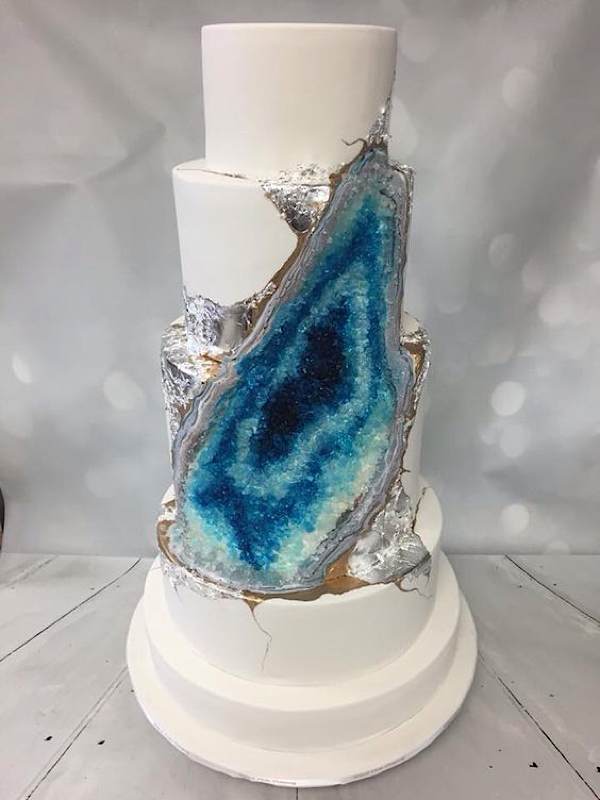
a white layered cake with a blue candy geode decoration

Cake by Whisk Cake Company, http://www.whiskcakes.com

A talented baker made this geode layer cake with fondant for the layers and a rock candy geode surrounded by gold and silver leaf. I am very impressed with the banding in the geode. It looks very tasty. This cake was recently featured on Cake Wrecks in their Sunday Sweets section, which is a day of beautiful cakes to contrast with the awful cakes on other days. There are other geode and rock-related cakes including a malachite cake posted that day, so be sure to go to the Cake Wrecks post “Oh Em Geode” and see the rest.

Fairburn Agates

Special guest article from Show-Me Rockhounds club members Dan and Connie Snow

Fairburn agate fortification agate

Group picture of Fairburn agates – Dan Snow

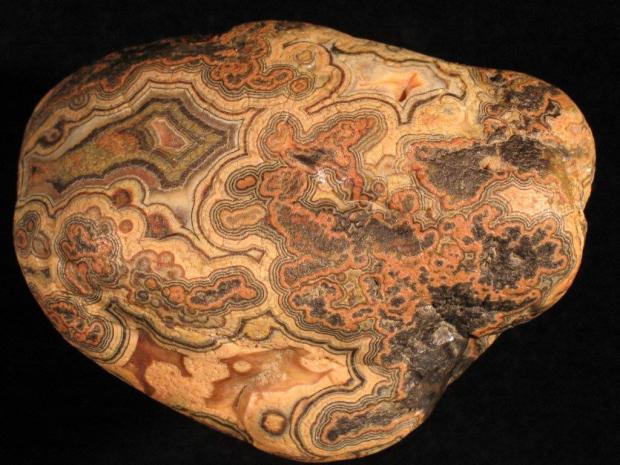
Fairburn agates are a form of microcrystalline chalcedony, 100% silicon dioxide with a hardness of 6 ½ to 7 on the Mohs scale.  They are also called fortification agates because of their banding.  They were formed approximately 300 million years ago in an ancient limestone bed of an inland sea.  To hunt Fairburn agates requires looking at every rock and turning many with a rock pick.  It is strictly surface hunting no digging, mining, cracking or breaking rocks.   The photos shown are exactly the way the agates were found, with no cutting, polishing or tumbling having been done.

Fairburn agate fortification agate

Frog Rock – Dan Snow

Fairburn Agates found by Dan and Connie Snow. Collected from the Fairburn Agate beds of South Dakota and the Oglala National Grasslands in Nebraska.

Association Picnic 2016

picnic
The Association Picnic will be held Sunday, August 28th at Antioch Park, Shelter 3. Swap begins at 9am, picnic around 12:30-1:00pm, auction after lunch. Meats, drinks, plates, etc. will be provided by the Association. Please bring a potluck side dish (e.g. beans, chips, veggies, potato salad, etc.), and dessert. Also bring cash to spend at the auction, which benefits the scholarship fund. Everyone is welcome.

Curb Showing Hayward Fault is Replaced

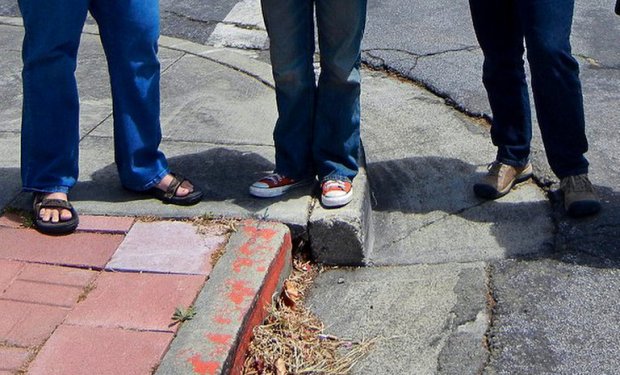
Hayward, California is the home of the Hayward Fault, which is a break in the Earth’s crust. Geologically speaking the Hayward Fault moves very fast. You can see that the tectonic plates are always moving when you look at the roads. Since it only moves a few millimeters a year, the roads and/or curbs don’t crack but instead gently wiggle apart at the seams.[*] See how this curb at Rose and Prospect has moved over time?

curb a few inches offset hayward fault

This is how the curb looked in 1974. It has already drifted several inches from where it was originally. Photo from http://www.geologyfieldtrips.com/haywardresidential.htm

hayward fault curb 2012 with people standing on top

This is how the curb looked in May 2012. See how far this piece has moved away? Photo by Andrew Alden at oaklandgeology.wordpress.com

If you want to go to California and see it for yourself, you are out of luck. The city has just replaced the curb. This is probably the first time that road work has made it into the New York Times. Read the article here: A Curb is Repaired and a Seismic Marker is Lost

[*]Note: Cracks in the road are not caused by plate tectonics. They are caused by thermal expansion/contraction, road salt, heavy trucks, and degredation of the road bed.

Labradorite

Labradorite has become a popular gemstone because of the unique iridescent play of color that many specimens exhibit.  Labradorite is a feldspar mineral of the plagioclase series that is most often found in mafic igneous rocks such as basalt, gabbro and norite.  Some specimens of labradorite exhibit a Schiller effect, which is a strong play of iridescent blue, green, red, orange, and yellow colors as shown in the photographs above. The Schiller effect is also seen in fire agate and mother of pearl. Labradorite is so well known for these spectacular displays of color that the phenomenon is known as “labradorescence.” Specimens with the highest quality labradorescence are often selected for use as gemstones. Labradorescence is not a display of colors reflected from the surface of a specimen. Instead, light enters the stone, strikes a twinning surface within the stone, and reflects from it. The color seen by the observer is the color of light reflected from that twinning surface. Different twinning surfaces within the stone reflect different colors of light. Light reflecting from different twinning surfaces in various parts of the stone can give the stone a multi-colored appearance.

Source: http://geology.com/gemstones/labradorite/

Minerals in Fireworks

The 4th of July fireworks that we saw last night would not be possible without minerals. Fireworks mainly contain gunpowder, which is a combination of charcoal, sulfur, and the mineral potassium nitrate. In order to create the pretty colors we are used to seeing in fireworks, mineral salts are added. This infographic from Compound Interest explains which mineral salts create which colors. If you go to the website, you can read a lot more about the chemistry of fireworks and a brief explanation of why different minerals make different colored flames.

I learned that blue fireworks are very difficult to produce because copper chloride breaks down at high temperatures, so they have to somehow keep the temperature hot enough to ignite but not so hot that the blue color vanishes. Thus, you almost never see purple fireworks because it is a combination of red and blue.

World’s Largest Uncut Diamond Up for Auction

hand holding largest uncut diamond from Lucara

Photo by Donald Bowers/Getty Images for Sotheby’s

From the New York Times, June 27, 2016:

In the fall of 2015, a 1,109 carat white diamond was found in the Lucara mine in South Africa. The diamond is called the Lesedi La Rona, which means “Our Light” in Setswana. On Wednesday, June 29, 2016 it will go up for public auction at Sotheby’s in London. Usually, precious stones like these are sold secretly by sealed bids and kept anonymous, so this Sotheby’s auction is unusual. This is the first time that such a large diamond has been on sale publicly.

The Lesedi La Rona is a type IIA diamond, which is very rare and is the most chemically pure type of diamond. Other famous IIA diamonds include the Koh-i-Noor and the Cullinan, which is 3,106 carats and is the biggest diamond ever found. The Cullinan was cut into 9 different stones and the pieces are now owned by various monarchs. Sotheby’s says that “whoever buys the Lucara stone will pay Sotheby’s a 12 percent fee, known as the buyer’s premium, on the hammer price for anything over the first $3 million, and a higher percentage of the first $3 million.” Whoever buys the stone will then have to decide if they want to have it cut. What a hard decision! What would you do?

The whole article is here: http://www.nytimes.com/2016/06/28/business/worlds-largest-uncut-diamond-heads-to-auction-a-break-with-tradition.html

UPDATE: It turns out nobody bought the diamond because the bids failed to meet the minimum reserve price. The reserve price was secret (just like at eBay) but it must have been more than £45 million ($61 million) because that was the highest bid. Maybe it will go on sale again later. Source: http://www.bbc.com/news/uk-england-london-36660076

Delightful Daylilies

pink and yellow daylily

Photo by Stephanie Reed

The Snows had a delightful daylily party at their place this weekend! First there was food, then we viewed their amazing rock collection in their impeccably organized basement (complete with a fluorescent rock display that rivals several museums), then we saw their daylily garden and had a walk through the woods! There was even a real turtle in the yard! Ed brought some teeth for Martin to identify and there are some photos of the teeth. I didn’t know there were so many different shapes and colors of daylily so there are tons more photos on the Google+ here.

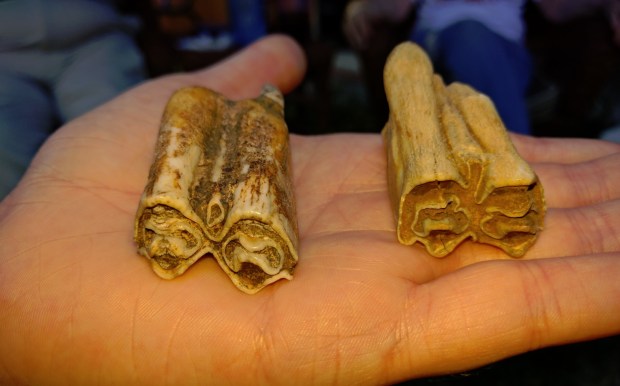
Since this is ostensibly a website about rocks and fossils, here’s a picture of two of the teeth. I don’t remember what Martin said they were.

two fossilized teeth in the palm of a person's hand

Photo by David Reed