minerals

All minerals are rocks, but not all rocks are minerals.

Cloud Agates

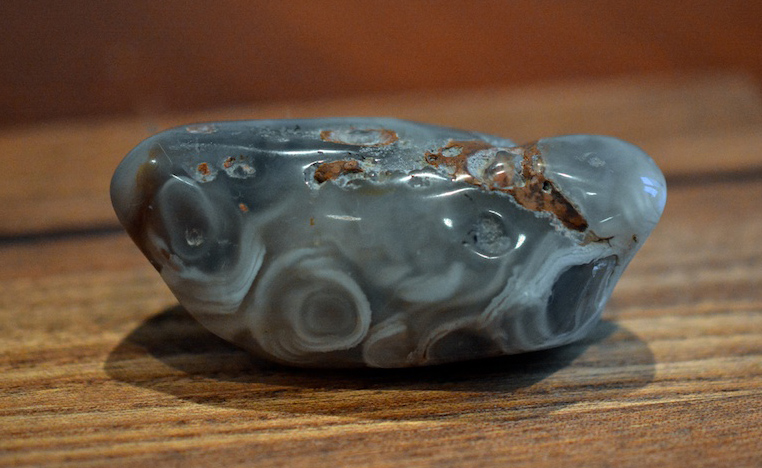
Cloud agates look like they contain clouds. They can have a gray or transparent matrix and the inclusions are usually white and foggy to look like clouds.  The one on the left has a bit of a drusy effect which makes it look like a puffy cumulus cloud.  The cloud agate on the right has a blue “cloud” inside.  The North Lincoln Agate Society has given its friend some googly eyes.
Chinese Rain Flower Agates

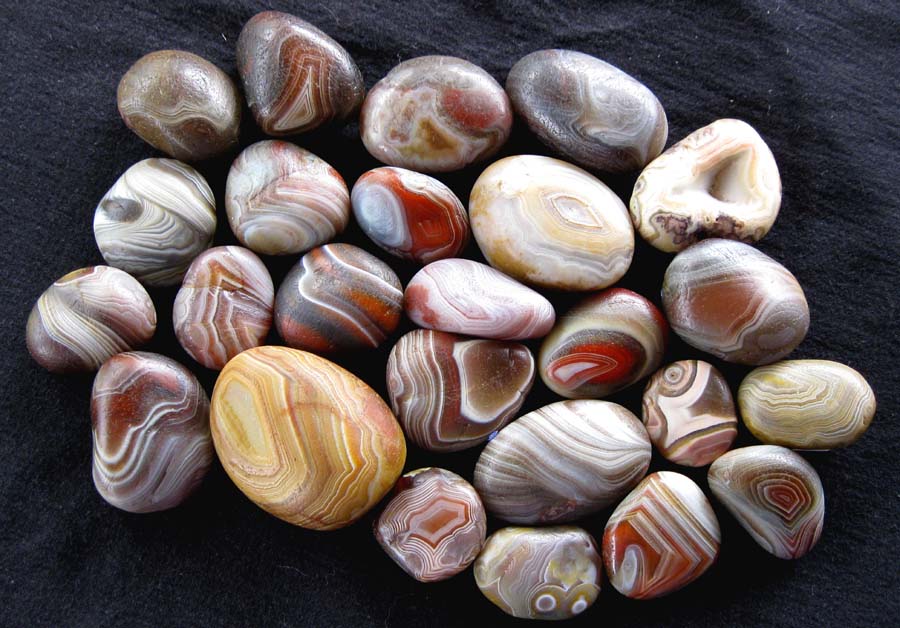
Chinese rain flower agates are found in Nanijing, China in the bed of the Yangtze River.  They can also be called Yuhashi or Yuhua stones.  The river polishes them smooth, and people often display them in a small bowl of water to bring out the colors.  They look very similar to Lake Superior agates, and like Lake Superior agates, they are named after where they came from.

Landscape Agates

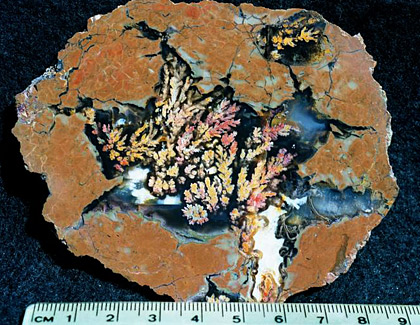
A landscape agate is any agate with inclusions that appear to be a landscape scene.  This usually includes plumes or dendrites, because they look so much like trees. I was unable to find the original sources for some of these cabochons, but I think the beautiful photos speak for themselves.  Which one is your favorite?

Enhydro Agates

A blue-gray polished agate with circular swirls.  You can't see it, but there is water inside.

Photo by Verity Woolf, from collection of Jo Woolf.  Retrieved from: http://the-hazel-tree.com/2014/01/06/enhydro-agate-a-secret-water-chamber/

Sometimes, agates will have a little bubble of water trapped inside.  This is called an enhydro.  The water inside is millions of years old!  The water can be seen if you shine a light on the agate from behind, or heard if you shake it.  Eventually, the water will work its way out and evaporate via small capillaries, but the hollow part will still remain.  It is also possible that water could enter the agate through the same capillaries.  Enhydros can be found in watery places where agates are found, such as Brazil, Indonesia, and Oregon.  Photos don’t show this very well, but on the link in the photo, the owner has some videos that show off the water inside.

For more information about enhydros, go here: http://www.rocksinmyheadtoo.com/Enhydros.htm

Agates and Jasper

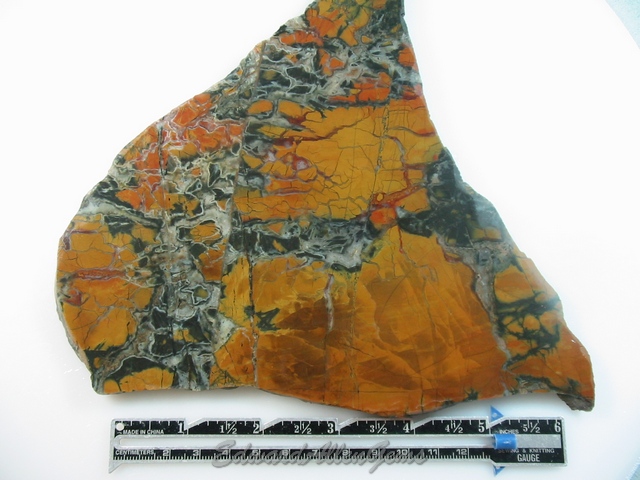
Jasper and agates are both a type of quartz known as chalcedony. So it makes perfect sense that sometimes you can find jasper and agate melded together, like so. Agates are usually transparent or translucent, and jasper is usually opaque, but this isn’t a hard and fast rule. Sometimes it’s very difficult to tell the difference between agate and jasper, in which case people may call it chalcedony, agate jasper, or jaspagate. It is mostly found in the American Southwest and California, like other agates and chalcedonies. The one pictured was found near the San Andreas Fault.

Thunder Eggs

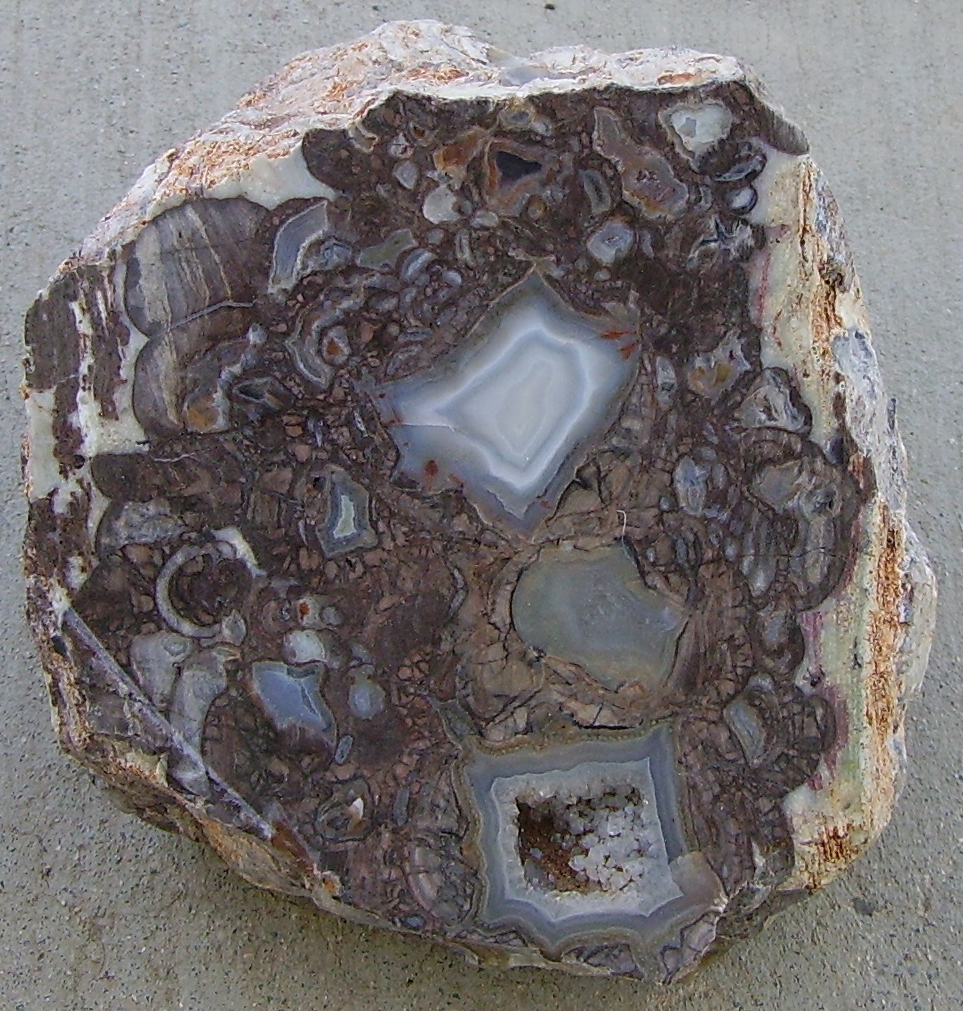
The thunder egg was declared the official state rock of Oregon in 1965, because there are quite a lot of them there. A thunder egg is a rounded nodule or geode with agate in the center.  Thunder eggs can also contain quartz, chalcedony, crystals, or opal.  The inside parts can be opaque or transparent – there are almost as many possible designs as there are agates.  This unusual thunder egg shown above is from Oregon and has plume inclusions. Some thunder eggs are also geodes but this one is not a geode because it does not have crystal points. A more typical thunder egg would look similar, but with bands or a single color on the inner part.

Think Pink: Think Thulite

A roughly triangular chunk of rock covered with bubblegum-pink splotches.  They sparkle slightly against the contrasting blue background.

Photo by David J. Eicher, http://www.mindat.org/photo-378407.html

It’s pretty hard not to notice that October is Breast Cancer Awareness Month.  Everything is awash in pink here, even the fountains.  So, I thought I would highlight an interesting pink mineral.  Thulite is a a pink variety of zoisite, a crystal, and it’s pink because it contains manganese.  Thulite is named after Thule, which was the ancient name for Norway (or sometimes when talking about far-off places in general, like when Virgil wrote about “Ultima Thule”).  It is most often found in Norway, Scandinavia, and sometimes North Carolina.  Susan G. Komen estimates that 232,030 cases of invasive breast cancer will be diagnosed in the U.S. this year, so now that you’ve read this, go do your breast self-exam!

Iris Agates

A round, thin, flat slice of agate with rainbow-colored concentric circles that makes it look very much like a compact disc.

Specimen from the National Mineral Collection, photo by Chip Clark. http://geogallery.si.edu/index.php/en/1177807/agate

Iris agates are very finely banded (15-30 bands per millimeter) iridescent agates that I like to call CD agates.  In order to see if an agate has the iris effect, you must bring it home, cut off a thin slice, and hold it up to the light.  The slices also have to be cut perpendicular to the banding to see the rainbows.  The rainbow effect occurs because the thin layers of agate split up the visible light into many beams of different wavelengths, which correspond to different colors.  This is also known as a diffraction grating, and it’s also the reason why CDs have rainbow patterns.

If you would like a technical explanation of how iris agates act as diffraction gratings read this: http://www.minsocam.org/msa/collectors_corner/arc/iris.htm