Announcing Agate Month

Hello, readers!  First of all, thanks for reading the Show-Me Rockhounds Blog, even if you don’t live in Kansas City or you don’t collect rocks. I really appreciate all of you.

Second of all, I hereby declare October to be Agate Month.  You are probably familiar with banded agates and maybe a few other types, but wait until you see how many other colors and patterns there are.  So follow us as we post a unique agate every weekday for the month of October.

Spessartine

You may remember our earlier post about uvarovite, the green garnet.  Spessartine is another garnet group mineral.  Notice how similar the crystals look, except for spessartine being reddish orange (and a bit of yellow in there, too) and uvarovite being green.  It is named after where it was first found: the German city Spessart, in the state of Bavaria.  The specimen pictured was found in the Broken Hill district in New South Wales, Australia.  It can also be found in Madagascar, China, Myanmar, India, Afghanistan, Israel, and parts of the United States such as Maine and Colorado.  Look for it in granite pegmatite and also sometimes in metamorphic phyllites.

If you liked these posts, you may wish to research the other garnet group minerals: almandine (purplish-red to orangish-red), andradite (can be black, green, or yellow-green), grossularite (brown to yellow), pyrope (very dark red to black), and tsavorite (light to dark green).

Uvarovite

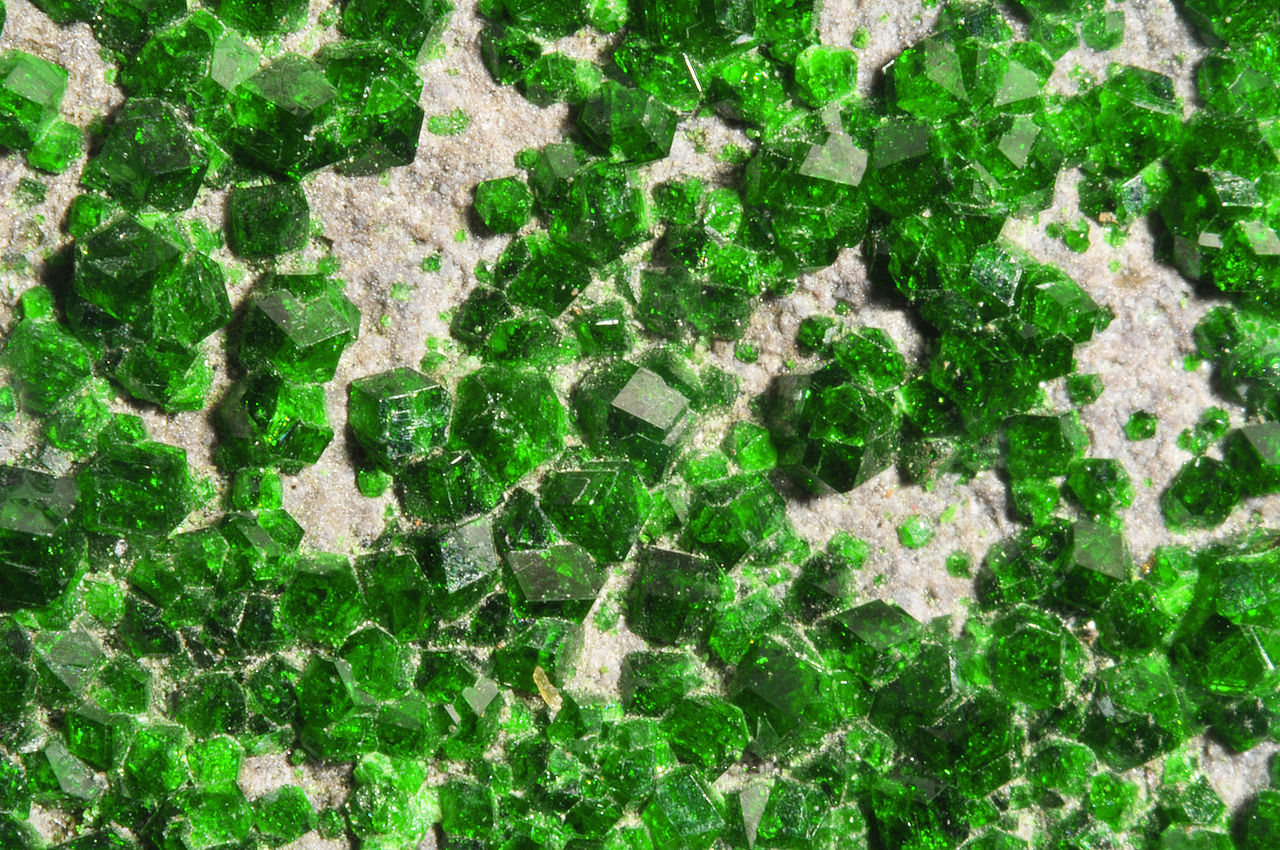
Uvarovite is a garnet group mineral, meaning that it’s structurally and compositionally similar to garnets, but unlike garnets, it is green. Uvarovite is named after Count Sergei Semenovitch Uvarov, a Russian statesman who was also quite the rockhound. It’s usually found in Russia, Spain, and Canada.  The photo above is an extreme close-up, and may be misleading.  Uvarovite crystals are usually about 2 mm long, so in “real life” it looks more like a plate of drusy quartz.  Here’s how it looks from a bit farther away:

A plate of tiny green sparkly crystals of uvarovite.

Photo by Rob Lavinsky, retrieved from Mindat http://www.mindat.org/photo-118217.html

This specimen is from the Saranovskii Mine in Russia, and I think it’s quite pretty, don’t you?

Bivalves

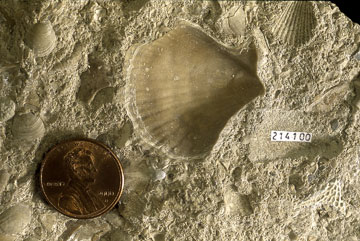
A fossil of a shell in light brown limestone. It's a little larger than an American penny.

Photo by John Charlton, Kansas Geological Survey.

Pictured here are some Pennsylvanian bivalves in limestone, collected near Bonner Springs, Kansas. (By Pennsylvanian, we mean the Pennsylvanian Period 323 – 290 million years ago.) But what is a bivalve? Bivalves have hard shells with two parts called valves and are usually bilaterally symmetrical, which means that their left and right sides look the same.  Bivalves belong to the Kingdom Animalia, Phylum Mollusca, Class Bivalvia, and include clams, oysters, scallops, and mussels. Bivalve fossils date back all the way to the Cambrian Period, 510 million years ago.

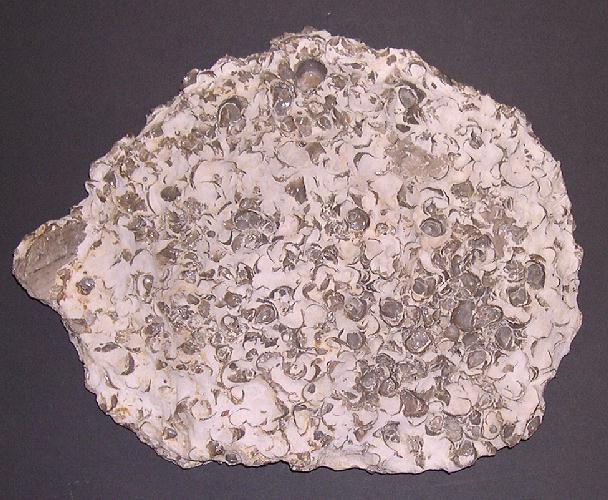
If you want to find one, Kansas is a pretty good place to start looking.  Kansas has a lot of limestone and shale which is chock full of fossilized clams and oysters.  You might find a little one like in the photo above, or you could find an inoceramid clam, some of which were up to 6 feet in diameter.  Inoceramid clams are extinct, but they used to live on the ocean floor around western Kansas during the Cretaceous Period about 145 to 65 million years ago (yes, the Midwest used to be underwater). This one is about a foot long and you can see that the back is covered in oysters

Volviceramus grandis a big clam fossil seen from the front

Mike Everhart, Oceans of Kansas

Volviceramus grandis a big clam fossil seen from the back with a bunch of fossil oysters attached to it

Mike Everhart, Oceans of Kansas

Sources: Geo Kansas: http://www.kgs.ku.edu/Extension/fossils/bivalve.html Oceans of Kansas http://oceansofkansas.com/Inoceramids.html

Chondrodite on Magnetite

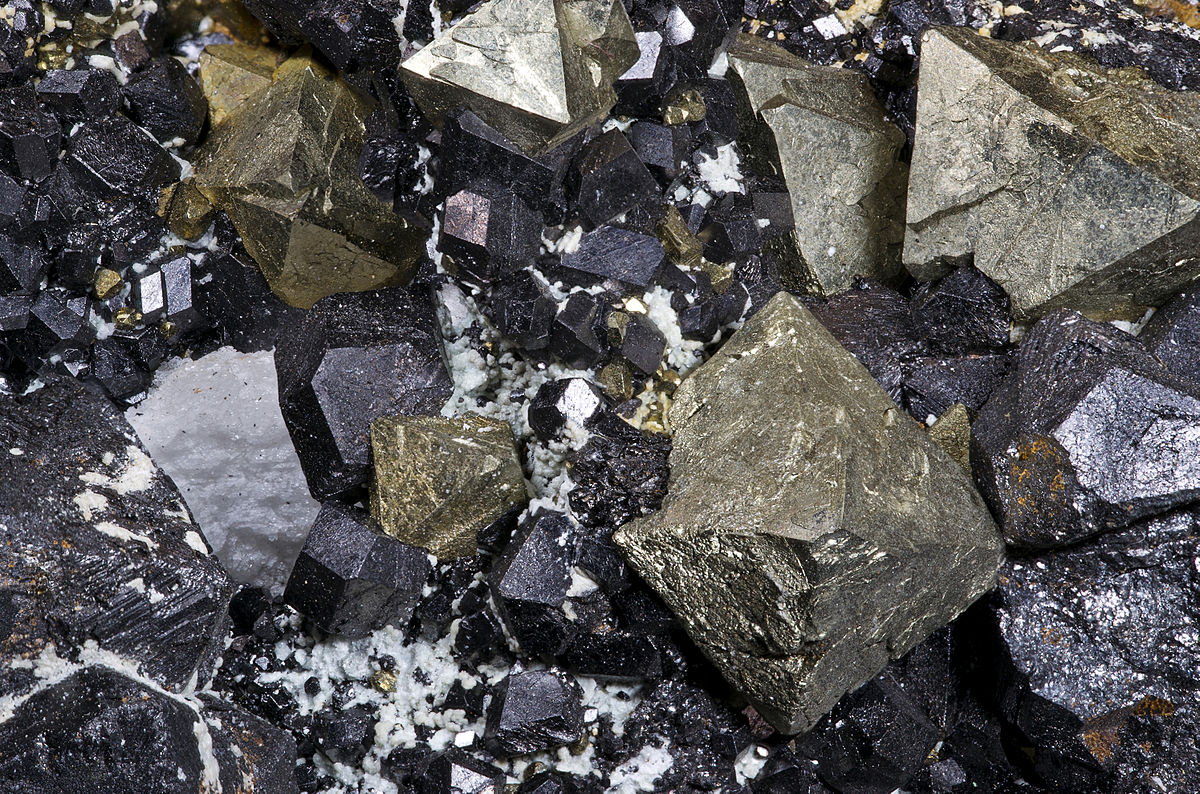
A shiny black chunk of pyramidal magnetite with glittering red crystals of chondrodite on top

Photo by Rob Lavinsky, retrieved from Mindat at http://www.mindat.org/photo-37952.html

A shiny black chunk of pyramidal magnetite with glittering red crystals of chondrodite on top. It was found in the Tilly Foster Iron Mine in New York. Since it measures only 2.8 x 2.6 x 2.1 cm, if you’re on a desktop or tablet, you’re viewing it larger than actual size.

Fossilized Leaves for the First Day of Fall


Happy first day of fall!  Or happy first day of autumn, if you prefer.  To celebrate, here are some great fossil leaves from fossilplants.com.

Granite

Did you know granite is not a mineral?  Granite can’t be called a mineral because it is a mixture of many other minerals.  Specifically, granite is a felsic (contains a lot of feldspar and quartz) intrusive (used to be liquid underground and was pushed up) igneous rock (made from magma or lava that has cooled and solidified) with at least 20% quartz and up to 65% alkali feldspar by volume.  Sometimes it contains plagioclase feldspar, muscovite, biotite, and hornblende-type amphiboles as well.  Different ratios of all these minerals in the mixture are what create all of the different colors and varieties of granite.  Phew!  That was a lot of definitions.  If you need me, I’m going to drive by the granite store in Grandview.  They leave their big slabs outside so you can look at them at any time of day.  I guess granite slabs are too heavy to steal.