crystals

Organized, homogeneous minerals. Rock collectors love to find crystals.

Apatite

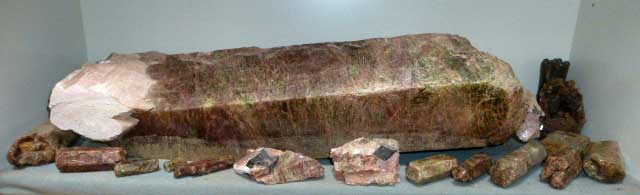
Apatite is a general name for a group of very soft phosphate minerals that form big crystals that are fun to collect. This red and green double-terminated apatite crystal is 21 inches long! It was found on the Miller Property in Eganville, Ontario, Canada during a CCFMS (Central Canadian Federation of Mineralogical Societies) field trip in July 2002. For more photos and information, and a cute poem about collecting apatite, check out the website linked in the photo, http://www.rocksforkids.com/R&M/apatite.htm

UPDATE 2017/06/02: Rocksforkids.com reorganized their website and the apatite page is no longer there. So, here is the apatite poem.

A Poem about Rock Collecting – Digging for Apatites in Eganville, Ontario

DUST CLOUDS

The peaceful silence of the northern woods, interrupted by a wail,
A soaring screaming roar, louder than a stomped on tigers tail.
A cloud of dust obscures a man, how can he see to use that tool,
With nothing to cover his nose and ears, I think the man’s a fool.
Suddenly the screaming noise stops, I think I have gone deaf.
The dust cloud drifts on by, but I keep on holding my breath.
Out of this swirling maelstrom, staggered a large ghostly form,
Coughing and hacking, he lugged a saw that had caused this dusty storm.
I guess he had some trouble; his saw had broken down.
Behind the mask of dust, his face displayed a worried pasty frown.
I guess Nick was finished for the day; the Apatite can wait.
However, Elfi kept finding more crystals; and they were looking great
The best laid plans of mice and men sometimes go awry.
Nick had brought that saw along and he just had to give it a try.
While he cut one out for his wife, the others were finding more.
Soon Nick had a full time job, I began to hate that rock saws roar.
Crystals of Apatite, some of exceptional size, like something from a dream.
They cleared off a Calcite vein they looked like salmon going up a stream.
Now there is a quandary, do we go or do we stay,
The planned trip was interrupted, they stayed another day.

Part of us stayed to the plans, we took the scheduled trip.
More than half went back to the trenches, old Frank near had a fit.
Two more days of pounding, another broken saw,
More large crystals were being located, there ought to be a law.
Well this trip is finally over and we missed a place or two,
I cannot say it wasn’t interesting and I’m really not too blue.
Nick’s planning went out the window, next year will be better I am told,
I hope your appetite for Apatite is sated Elfi, next time pick on gold.

by Dick Stata Aug. 24th. Thinking back on the 2002 CCFMS summer trip.
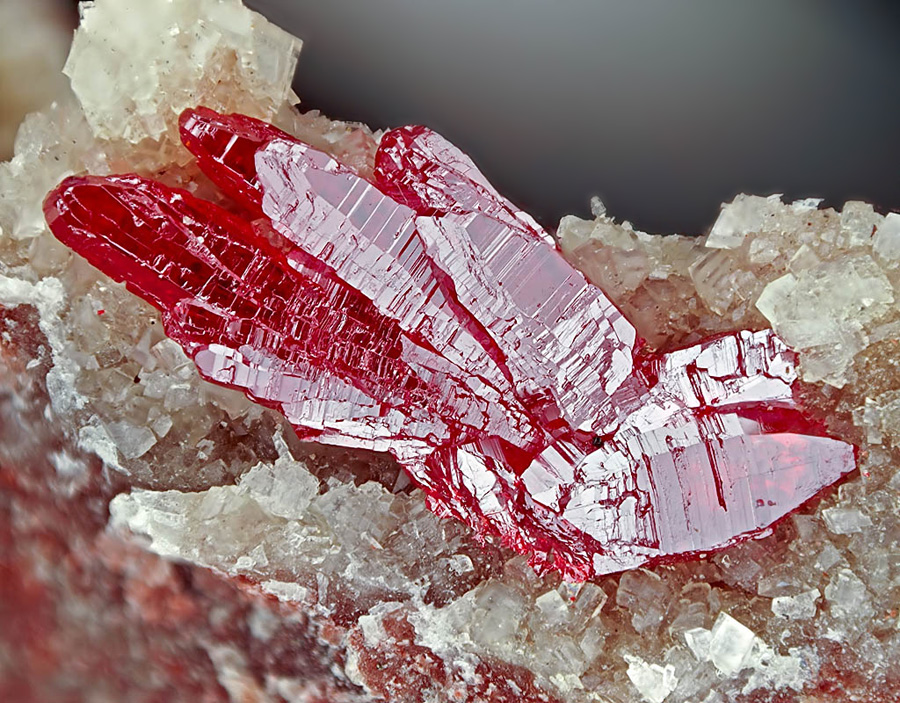
Cinnabar

Shiny red cinnabar from Germany. Also known as HgS, mercury (II) sulfide, cinnabar used to be mined to extract the mercury (mercury is only found in ores like cinnabar, calomel, and livingstonite) or to be mixed with sulfur and used as red pigment. Due to mercury’s toxicity, it is no longer allowed in paints, pesticides, batteries, and many other products. In fact, the United States and many other countries have stopped mining mercury because of the environmental hazard and a decrease in demand.

If you own a cinnabar specimen, keep it in a glass cabinet or enclosed box, wash your hands after touching it, don’t break it and inhale the dust, and don’t let children or pets eat it.  These are good rules for your entire rock collection.

Think Pink: Think Thulite

A roughly triangular chunk of rock covered with bubblegum-pink splotches.  They sparkle slightly against the contrasting blue background.

Photo by David J. Eicher, http://www.mindat.org/photo-378407.html

It’s pretty hard not to notice that October is Breast Cancer Awareness Month.  Everything is awash in pink here, even the fountains.  So, I thought I would highlight an interesting pink mineral.  Thulite is a a pink variety of zoisite, a crystal, and it’s pink because it contains manganese.  Thulite is named after Thule, which was the ancient name for Norway (or sometimes when talking about far-off places in general, like when Virgil wrote about “Ultima Thule”).  It is most often found in Norway, Scandinavia, and sometimes North Carolina.  Susan G. Komen estimates that 232,030 cases of invasive breast cancer will be diagnosed in the U.S. this year, so now that you’ve read this, go do your breast self-exam!

Spessartine

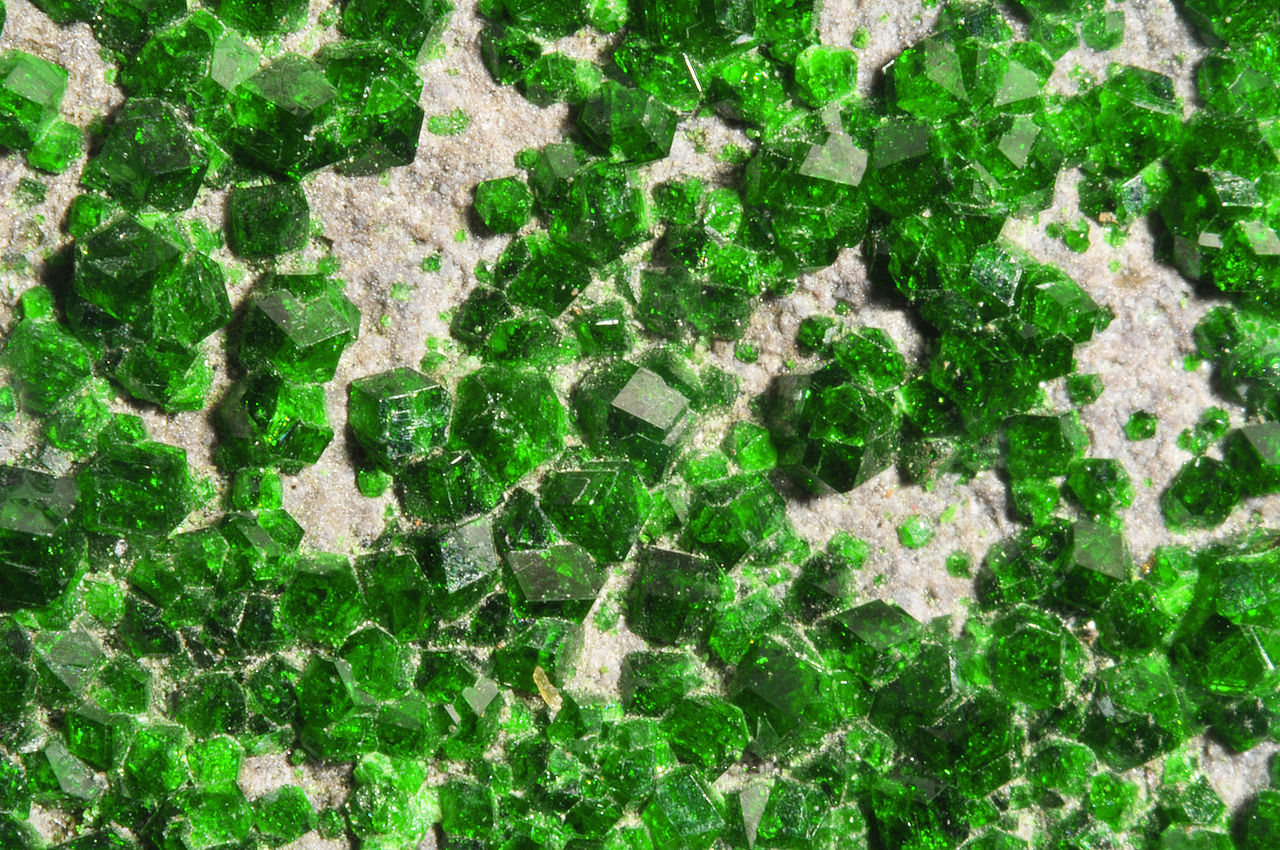
You may remember our earlier post about uvarovite, the green garnet.  Spessartine is another garnet group mineral.  Notice how similar the crystals look, except for spessartine being reddish orange (and a bit of yellow in there, too) and uvarovite being green.  It is named after where it was first found: the German city Spessart, in the state of Bavaria.  The specimen pictured was found in the Broken Hill district in New South Wales, Australia.  It can also be found in Madagascar, China, Myanmar, India, Afghanistan, Israel, and parts of the United States such as Maine and Colorado.  Look for it in granite pegmatite and also sometimes in metamorphic phyllites.

If you liked these posts, you may wish to research the other garnet group minerals: almandine (purplish-red to orangish-red), andradite (can be black, green, or yellow-green), grossularite (brown to yellow), pyrope (very dark red to black), and tsavorite (light to dark green).

Uvarovite

Uvarovite is a garnet group mineral, meaning that it’s structurally and compositionally similar to garnets, but unlike garnets, it is green. Uvarovite is named after Count Sergei Semenovitch Uvarov, a Russian statesman who was also quite the rockhound. It’s usually found in Russia, Spain, and Canada.  The photo above is an extreme close-up, and may be misleading.  Uvarovite crystals are usually about 2 mm long, so in “real life” it looks more like a plate of drusy quartz.  Here’s how it looks from a bit farther away:

A plate of tiny green sparkly crystals of uvarovite.

Photo by Rob Lavinsky, retrieved from Mindat http://www.mindat.org/photo-118217.html

This specimen is from the Saranovskii Mine in Russia, and I think it’s quite pretty, don’t you?

Chondrodite on Magnetite

A shiny black chunk of pyramidal magnetite with glittering red crystals of chondrodite on top

Photo by Rob Lavinsky, retrieved from Mindat at http://www.mindat.org/photo-37952.html

A shiny black chunk of pyramidal magnetite with glittering red crystals of chondrodite on top. It was found in the Tilly Foster Iron Mine in New York. Since it measures only 2.8 x 2.6 x 2.1 cm, if you’re on a desktop or tablet, you’re viewing it larger than actual size.