Article by Amir Chossrow Akhavan, http://www.quartzpage.de/gro_text.html
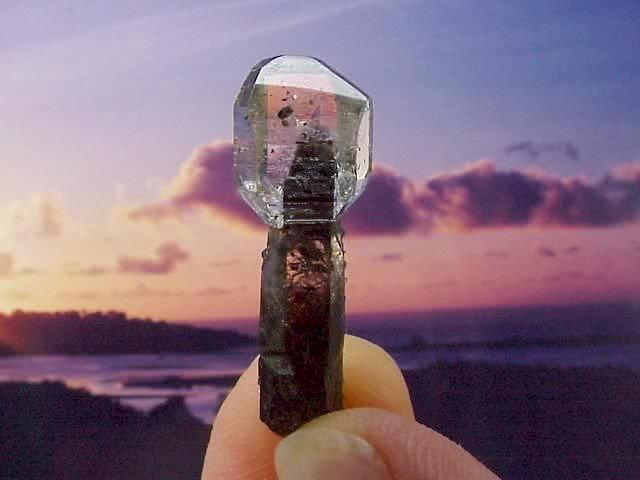
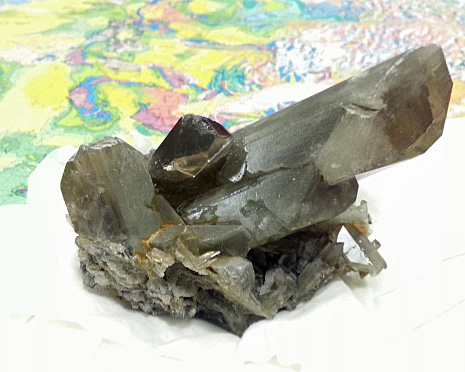
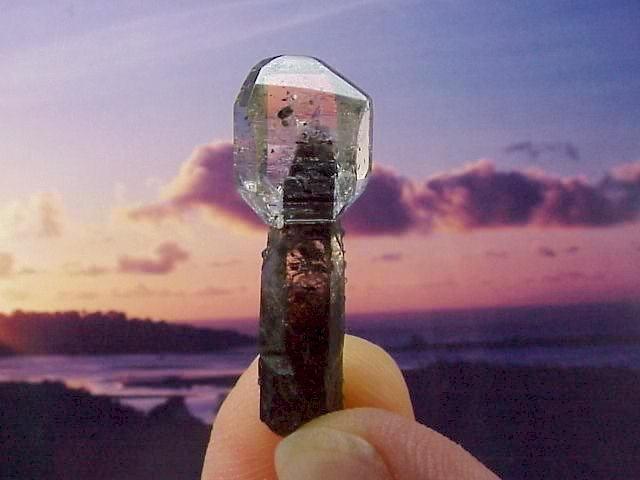
A scepter quartz is often defined as a quartz crystal that has a second generation crystal tip sitting on top of an older first generation crystal. The second generation tip typically becomes larger than the first generation tip, but might also become smaller. A scepter can be shifted sideways and does not need to be centered on the first generation tip.
However, there is a problem with a definition that is based on the idea of a second generation: scepters do not only occur as a second generation on an older crystal, they also form stacks of parallel grown crystals that developed at the same time, very often as skeleton quartz. Another difficult case are reverse scepters in which the scepter is smaller than the underlying tip. Here the smaller tip very often does not show any properties that clearly distinguish it from the rest of the crystal and that would justify calling it a second generation. Instead, the crystals often appear to have grown continuously into the reverse scepter or multiple scepter shape.
In all cases, the scepter develops from the already present crystal lattice of the crystal underneath. Thus, to be a scepter quartz, the “second generation” crystal’s a- and c-axes need to be oriented parallel to the respective axes of the “first generation” crystal; just one crystal on top of another doesn’t make it a scepter. Such a crystallographically well defined intergrowth of different minerals is called an epitaxy. In a sense, a scepter represents an epitaxy of quartz on quartz, and because it is the same mineral, it is sometimes called an autotaxy.
Scepters are quite common in certain geological environments. Amethyst from alpine-type fissures in igneous and highly metamorphosed rocks usually occurs as scepters on top of colorless or smoky crystals (not only in the Alps, but for example also in southern Norway or northern Greece). Here, the amethyst generation grew at lower temperatures than the first generation quartz. The same growth form can be observed in pegmatites and miaroles in igneous rocks (for example, amethyst scepters from the Brandberg, Namibia, or from pegmatites in Minas Gerais, Brazil).
Scepters, or to be precise, the “second generation” part of a scepter quartz that defines it, commonly have a number of morphological properties:
- Scepters are commonly of normal habit and are never tapered. The underlying “first generation” crystal may show a Tessin habit, but the scepter on it will not.
- Scepters tend to assume a short prismatic habit. An apparent exception are reverse scepters and the normal scepters associated with them, which may occur as elongated extensions of a “first generation” crystal, but then in the shape of multiple stacked scepters.
- Many scepters show only a weak striation on their prism faces, sometimes it is even missing.
- Scepters do not show split growth patterns.
- Scepters rarely show trigonal habits with very small or missing z-faces. An exception are reverse scepters and the normal scepters associated with them.
- Scepters are often associated with skeleton growth forms (skeleton or window quartz).
- Scepters commonly show a color, color distribution, diapheny and surface pattern that is markedly different from the underlying “first generation” crystal. Often they are more colorful and transparent. Amethyst scepters are very common, smoky quartz scepters -often with uneven color distribution- are common. An exception are reverse scepters and the normal scepters associated with them which seem to either not differ from the “first generation” or show gradual transitions.
- Summarizing the exceptions above: Reverse scepters and the normal scepters associated with them seem to have a different set of properties.
Formation
One theory is that a scepter forms when crystal growth is interrupted and parts of the crystal are covered with some material that inhibits further growth. The growth inhibiting material might be only present as a very thin layer and invisible. The very tip of the crystal or the entire rhombohedral faces remain free of that material, and should the conditions change again, the crystal continues to grow from the tip.
One of the problems with that theory is that you would expect to see a larger number of “double”, “triple” or “quadruple scepters”, specimen in which the growth had been interrupted several times and in which scepters with slowly changing habits are stacked. In nature, however, you see a strong dominance of “simple” scepters that consist of just a prism with “a single head”. If you see multiple scepters, then often alongside simple scepters, although multiple changes in the environment should have affected the morphology of all of them equally.
Another problem is that you would not expect to see a fully-grown scepter that encloses the former tip like an onion if the crystal simply started growing from a single point on the surface of the tip. Such a crystal would finally grow into an elongated crystal and would at best assume the shape of a reverse scepter.
As I’ve mentioned, amethyst from igneous and metamorphic rock locations all over the world predominantly occurs as scepters. Even if you just take Alpine locations, it is hard to imagine that the environmental conditions in all those locations have undergone a single sudden change that led to a temporary growth inhibition on the crystals, followed by a very distinctive growth pattern, the formation of scepters.
The internal structure of scepters from Alpine-type fissures (and of scepters in general) is perhaps always lamellar, as opposed to the macromosaic structure of many quartz crystals from Alpine-type fissures. Quartz crystals with a macromosaic structure may carry a scepter, but the scepter will then show lamellar structure.







 Show-Me Rockhounds Kansas City