science

How we add to the sum of the world’s knowledge.

Curb Showing Hayward Fault is Replaced

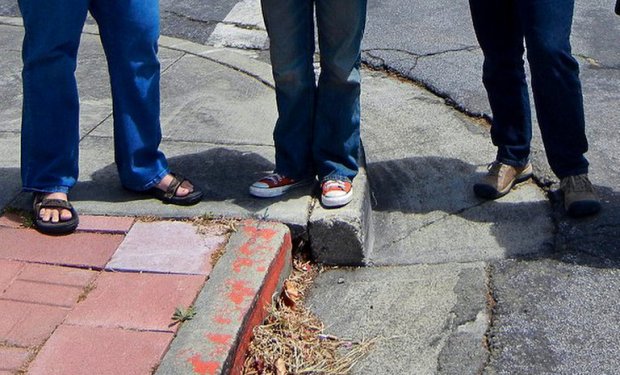
Hayward, California is the home of the Hayward Fault, which is a break in the Earth’s crust. Geologically speaking the Hayward Fault moves very fast. You can see that the tectonic plates are always moving when you look at the roads. Since it only moves a few millimeters a year, the roads and/or curbs don’t crack but instead gently wiggle apart at the seams.[*] See how this curb at Rose and Prospect has moved over time?

curb a few inches offset hayward fault

This is how the curb looked in 1974. It has already drifted several inches from where it was originally. Photo from http://www.geologyfieldtrips.com/haywardresidential.htm

hayward fault curb 2012 with people standing on top

This is how the curb looked in May 2012. See how far this piece has moved away? Photo by Andrew Alden at oaklandgeology.wordpress.com

If you want to go to California and see it for yourself, you are out of luck. The city has just replaced the curb. This is probably the first time that road work has made it into the New York Times. Read the article here: A Curb is Repaired and a Seismic Marker is Lost

[*]Note: Cracks in the road are not caused by plate tectonics. They are caused by thermal expansion/contraction, road salt, heavy trucks, and degredation of the road bed.

Labradorite

Labradorite has become a popular gemstone because of the unique iridescent play of color that many specimens exhibit.  Labradorite is a feldspar mineral of the plagioclase series that is most often found in mafic igneous rocks such as basalt, gabbro and norite.  Some specimens of labradorite exhibit a Schiller effect, which is a strong play of iridescent blue, green, red, orange, and yellow colors as shown in the photographs above. The Schiller effect is also seen in fire agate and mother of pearl. Labradorite is so well known for these spectacular displays of color that the phenomenon is known as “labradorescence.” Specimens with the highest quality labradorescence are often selected for use as gemstones. Labradorescence is not a display of colors reflected from the surface of a specimen. Instead, light enters the stone, strikes a twinning surface within the stone, and reflects from it. The color seen by the observer is the color of light reflected from that twinning surface. Different twinning surfaces within the stone reflect different colors of light. Light reflecting from different twinning surfaces in various parts of the stone can give the stone a multi-colored appearance.

Source: http://geology.com/gemstones/labradorite/

Minerals in Fireworks

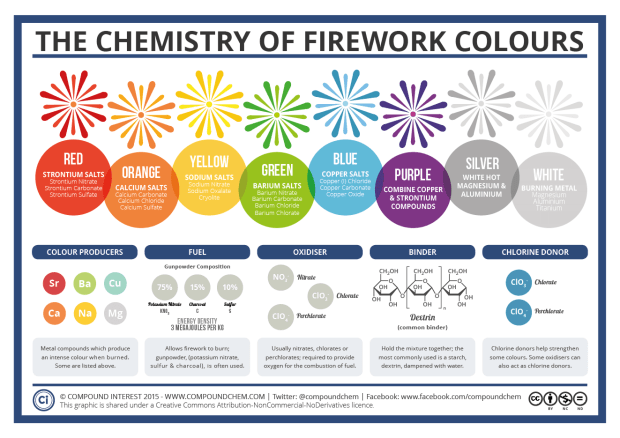
The 4th of July fireworks that we saw last night would not be possible without minerals. Fireworks mainly contain gunpowder, which is a combination of charcoal, sulfur, and the mineral potassium nitrate. In order to create the pretty colors we are used to seeing in fireworks, mineral salts are added. This infographic from Compound Interest explains which mineral salts create which colors. If you go to the website, you can read a lot more about the chemistry of fireworks and a brief explanation of why different minerals make different colored flames.

I learned that blue fireworks are very difficult to produce because copper chloride breaks down at high temperatures, so they have to somehow keep the temperature hot enough to ignite but not so hot that the blue color vanishes. Thus, you almost never see purple fireworks because it is a combination of red and blue.

Weathering

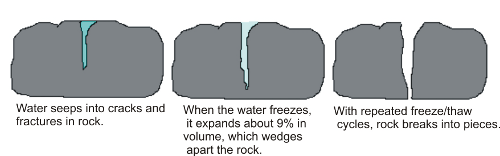
Weathering is when rocks break down in place, that is, without moving the rock. This is usually done by water, but there are plenty of other physical and chemical processes that break down rocks without moving them. Physical weathering occurs when a tree root grows into a rock and breaks through, when a river cuts through a canyon, when particles carried by the wind abrade the rock, or during the process of frost wedging, which is when water fills a crack in a rock and freezes, then the ice expands and makes the crack deeper. Chemical weathering can be caused by acid rain or even regular rain, as minerals in the water weaken the rocks and make it easier for them to be eroded or broken later. Minerals can even react with chemicals in the air (such as iron and oxygen reacting to form rust, also known as iron oxide) or with other minerals nearby. Minerals are made of chemicals, after all, and there is nothing stopping them from reacting with one another.

There are a lot of interesting ways that minerals can change due to weathering, both physical and chemical. For example:

  • Limestone dissolves
  • Calcite dissolves
  • Gold may dissolve if manganese is present
  • Silver minerals can change to horn silver (cerargyrite) or dissolve
  • Feldspar changes to clay
  • Olivine and hornblende change to serpentine or chlorite
  • Pyrite changes to limonite and hematite
  • Rhodochrosite and rhodonite change to psilomelane or pyrolusite (manganese) minerals
  • Copper sulfide minerals change to malachite, azurite, cuprite, or metallic copper, or may dissolve entirely
  • Some copper minerals become partly limonite

Adapted from an article in Cycad, Flint Chips, Osage Hills Gems 11/1992

Characterization of Green Amber

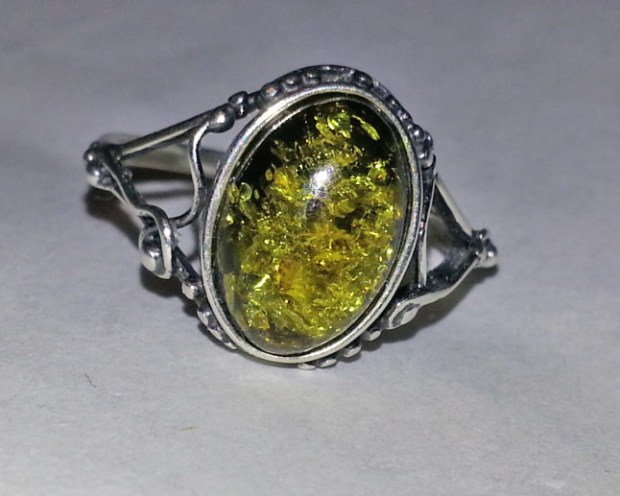
silver ring with oval green amber

Green amber ring owned by Stephanie. It has nothing to do with this article. Photo by Stephanie Reed

David highly recommends this article on green amber from Gems & Gemology, 2009. Here is the abstract.

Ahmadjan Abduriyim, Hideaki Kimura, Yukihiro Yokoyama, Hiroyuki Nakazono, Masao Wakatsuki, Tadashi Shimizu, Masataka Tansho, and Shinobu Ohki

Abstract: A peridot-like bright greenish yellow to green gem material called “green amber” has recently appeared in the gem market. It is produced by treating natural resin (amber or copal) with heat and pressure in two stages in an autoclave. Differences in molecular structure between untreated amber and copal as compared to treated “green amber” were studied by FTIR and 13C NMR spectroscopy, using powdered samples. Regardless of the starting material, the FTIR spectrum of “green amber” showed an amber pattern but with a characteristic small absorption feature at 820 cm-1. Solid-state 13C NMR spectroscopy of the treated material indicated a significantly lower volatile component than in the untreated natural resin, evidence that the treatment can actually “artificially age” copal. A new absorption observed near 179 ppm in the NMR spectra of all the treated samples also separated them from their natural-color counterparts.

To read the whole article, go here http://www.gia.edu/gems-gemology/fall-2009-green-amber-abduriyim and click on “Download PDF”.

Andradite Garnet

andradite garnet

Credit: Aaron Palke/Gemological Institute of America

Since it’s January, it’s a good time to read about this garnet originally posted by Chemistry in Pictures.

“This gemstone isn’t pure andradite garnet [Ca₃Fe₂(SiO₄)₃], but its flaws produce its mesmerizing colors. Some gemologists think that this rainbow explosion arises because the garnet’s different elements aren’t regularly spaced from the core of the gemstone to the outside. For example, in some regions, aluminum atoms might have worked their way into the structure and replaced the iron atoms. These irregularities create mismatched sheets of atoms that then bend and stretch. This makes the stone birefringent, meaning that light travels through it at two different speeds. Under cross-polarized lighting conditions, rays of light that enter get misaligned by the time they exit, so they then interfere with each other and highlight some colors in certain spots, producing the spectrum seen here. The black flecks are tiny pieces of magnetite that were enveloped by the crystal as it grew.”

Earth Science Week 2015

Earth Science Week is October 11-17, 2015

Earth Science Week logoEvery year, the Missouri Department of Natural Resources (MO DNR) has an Earth Science Week full of fun activities for kids and adults. From their website: Earth Science Week aims to help the public gain a better understanding and appreciation for the Earth Sciences and to encourage stewardship of the Earth. This year’s activities will be held Oct. 11-17 and will celebrate the theme “Visualizing Earth’s Systems.” This year’s theme will engage young people and others in discovering the Earth sciences, remind people that Earth science is all around us, encourage Earth stewardship through understanding, and to motivate geoscientists to share their knowledge and enthusiasm about the Earth.

Go ahead – be a citizen scientist!

Enter the photography, visual arts and essay contests! All eligible submissions must be submitted to the American Geosciences Institute and received electronically by 4 p.m. CST, Friday, Oct. 16, 2015.

Participate in events during Earth Science Week. Plan a visit to the Missouri Geological Survey during Earth Science Week. The Missouri Geological Survey will be open during Earth Science Week from 8 a.m. to 5 p.m., Tuesday-Friday, Oct. 12-16.

Read our Governor’s Proclamation!

  • Sunday, Oct. 11 is International EarthCache Day – Explore the world using your GPS.
  • Monday, Oct. 12 Earth Science Literacy Day Learn the fundamentals of geosciences with Earth Science: Big Idea, a video series developed to explain why Earth science literacy is important.
  • Tuesday, October 13 is No Child Left Inside Day  NCLI Day encourages students to go outside and research Earth science in the field like a professional geoscientist.
  • Wednesday, Oct. 14 is National Fossil Day – Visitors to the Ed Clark Museum of Missouri Geology, in Rolla, will receive a Crinoid fossil. Also, be sure to check out the fossils in the limestone of the Missouri State Capitol.
  • Thursday, Oct. 15 is The Great Central U.S. ShakeOut – Register and join millions in the “Drop, Cover, and Hold On” earthquake drill Oct. 15 at 10:15 a.m.
  • Thursday, Oct. 15 is Geoscience for Everyone Day Do your part to help young people from underrepresented communities explore exciting careers in the geosciences.
  • Friday, Oct. 16 is Geologic Map Day – Special mapping exhibits were on display at the Ed Clark Museum of Missouri Geology during Geologic Map Day to promote awareness of the study, uses and importance of geologic mapping for education, science, business, and public policy concerns.
  • Saturday and Sunday, Oct. 17 and 18 the Ozark Mountain Gem and Mineral Society’s Gem and Jewelry Show will be held in the at the Expo Center in Springfield, Mo. – Geologists with the Missouri Geological Survey will host an educational booth Saturday, Oct. 17.
  • Saturday, Oct. 17 is International Archaeology Day – Hosted by the Archaeological Institute of America, this special event is a celebration of archaeology and the thrill of discovery.

Chemical Composition of Gemstones

Here’s a neat infographic from Compound Interest (one of my favorite websites) that describes 16 different gemstones and why they have different colors. It also includes their chemical formulas and hardness on the Mohs scale.

Many gemstones would be colorless or a different color if not for the presence of small amounts of transition metals such as chromium or titanium. For example, you can see that aquamarine and emerald both have the same chemical formula Be3Al2(SiO3)6, but emeralds are green because of chromium ions replacing some of the aluminum ions and aquamarines are blue because of iron 2+ or 3+ ions replacing some of the aluminum ions. Click through to read the whole article, because there are many other ways that gems and minerals get their colors!

What color were the dinosaurs?

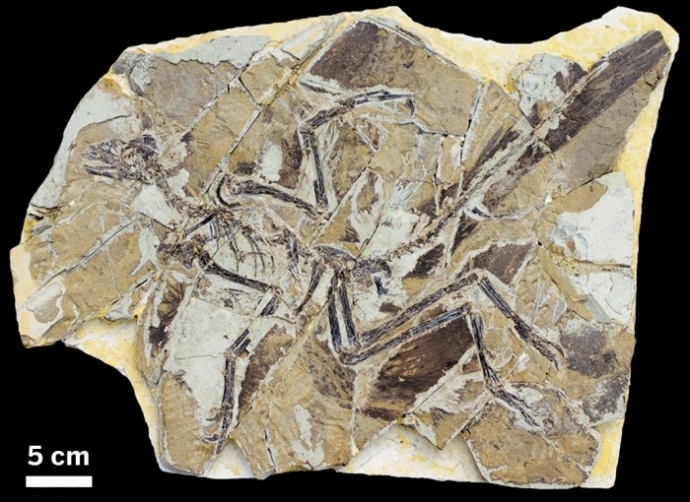
A dinosaur fossil of anchiomis huxleyi

Johan Lindgren/Sci. Rep.

In this article from Chemical & Engineering News, researchers use chemistry to find out what colors the dinosaurs were.

Researchers led by Johan Lindgren of Lund University, in Sweden, used a battery of analytical techniques to scrutinize the molecular makeup of a fossilized Anchiornis huxleyi specimen. This dinosaur is a distant relative of today’s birds, and its remnants were preserved for about 150 million years in what is now northeastern China.

The researchers’ thorough analyses have allowed them to conclude that some of the dinosaur’s melanin, or pigment molecules, and melanin-producing organelles have also survived the intervening epochs (Sci. Rep. 2015, DOI: 10.1038/srep13520).

Scientists have previously observed signs of similar biomaterials in fossils, but studies have lacked sufficient evidence to rule out the idea that these materials come from bacteria or other microbial intruders.

Using methods including infrared spectroscopy and time-of-flight secondary ion mass spectrometry, Lindgren and his colleagues have shown that the sample’s fossilized feathers contain substances that closely resemble modern animal—not bacterial—eumelanin, the pigments responsible for brown and black coloration.

Click here to read the whole article.

What Does a Research Geologist Do?

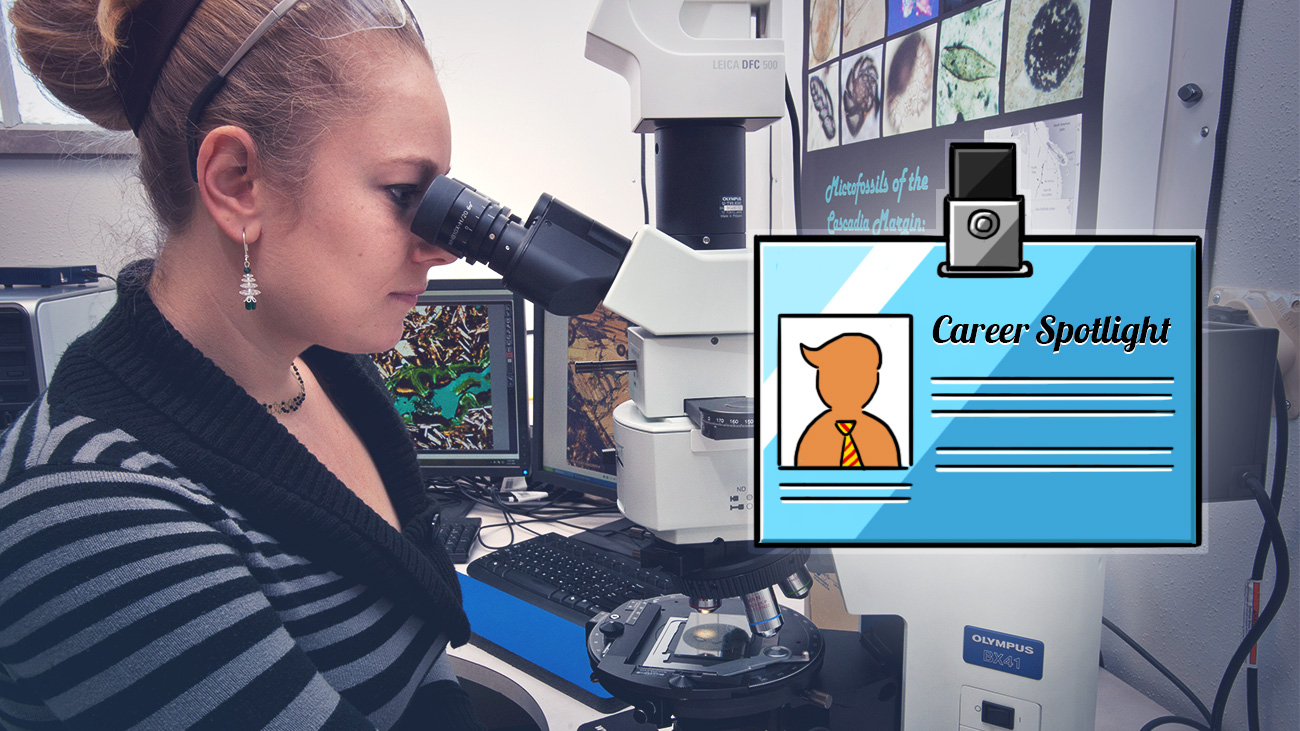
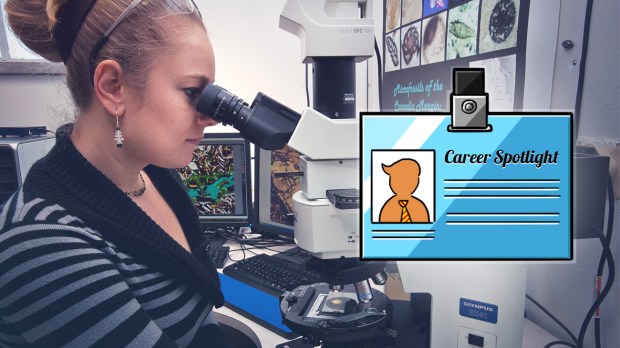
Research Geologist Career Spotlight title
An article originally by Andy Orin found on Lifehacker here: http://lifehacker.com/career-spotlight-what-i-do-as-a-research-geologist-1690402642

It’s appealing to think that a geologist spends most of their time scouring remote landscapes with a rock hammer and a magnifying glass, but in reality they spend more time in a laboratory than a Land Rover. The work of a research geologist is eclectic, analytical, and scientific.

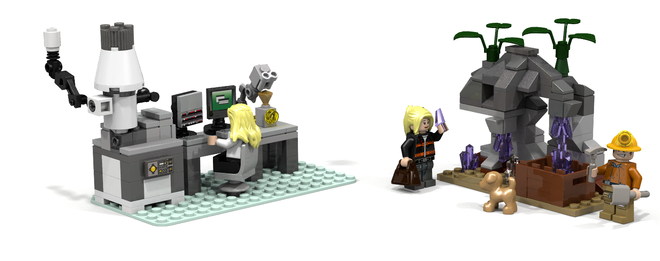
To learn a little about the field, we spoke with Circe Verba, Ph.D., a young researcher at the National Energy Technology Laboratory, and who has previously worked with NASA and SETI. Circe is also involved with science outreach and education with high school students, and has even designed a LEGO set depicting what it’s like to be a geologist. Now let’s take a look through the microscope:

Tell us a little about yourself and your experience.

I am a research geologist at the National Energy Technology Laboratory’s (NETL) Office of Research & Development (ORD). I specialize in bridging geochemistry and civil engineering—specifically projects that involve carbon sequestration and wellbore integrity (relevant to mitigating climate change) and understanding the interaction of oil-gas shale in unconventional systems. My expertise is electron microscopy and image analysis.

What drove you to choose your career path?

I had many inspirations as a child; it started with my earth science class with discovering the planets. I had a thirst for knowledge to understand processes at a macroscopic scale down to a micro-scale. Geology is a multidisciplinary science that spans several fields, such as engineering and research, which enabled me to pursue several interests.

How did you go about getting your job? What kind of education and experience did you need?

I wanted to pursue a career that would expand my perception of the universe by conducting research. I participated in high school science clubs which provided a scholarship opportunity to attend college at Oregon State University. Research (nowadays) requires a Ph.D., which took me long nine years. During my undergraduate, I explored astronomy, oceanography, and geology. I studied microbial boreholes in freshwater pillow basalt for planetary applications. Then I started a geology master’s program at Northern Arizona University, studying Martian aeolian [wind erosion] and volcanic features as part of a NASA HiRISE fellowship. Once that program ended, I switched gears and participated in an Oak Ridge Institute for Science and Education (ORISE) post-graduate fellowship in 2009. At NETL I was encouraged to further my education which led to the completion of my Ph.D in 2013, and a permanent job studying engineered systems on Earth.

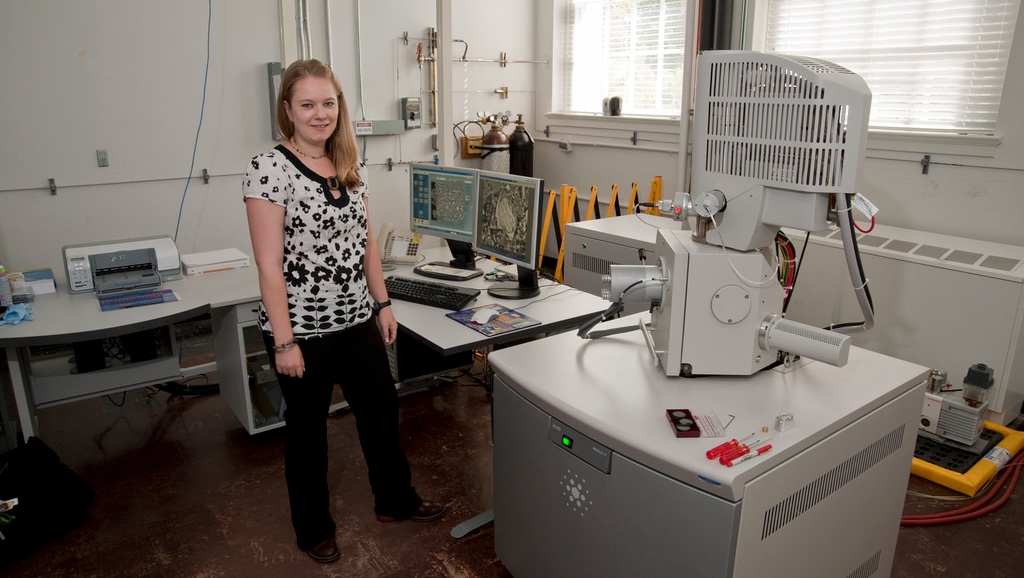
Verba in the lab with a SEM (Scanning Electron Microscope).

Verba in the lab with a SEM (Scanning Electron Microscope).

What kinds of things do you do beyond what most people see? What do you actually spend the majority of your time doing?

My time depends on what stage the project is at—at the moment I have four projects in different stages. I can spend time in the laboratory conducting experiments, analyzing and characterizing samples under an electron or light microscope, or working on the computer drafting manuscripts for publications. I also spend a lot of time interfacing with other team members and key partners from universities. It is also vital for scientists to communicate with one another on their work at scientific conferences.

What misconceptions do people often have about your job?

One misconception is not about my job, but more about the field. A common joke is that geology is rock for jocks, however, geology can be quite complex. In addition, as a geologist you get a lot of random rocks brought to you hoping for special identification when it’s usually a common rock like an agate (quartz-polymorph).
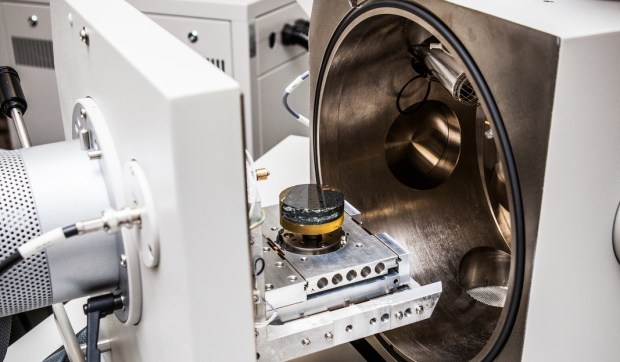
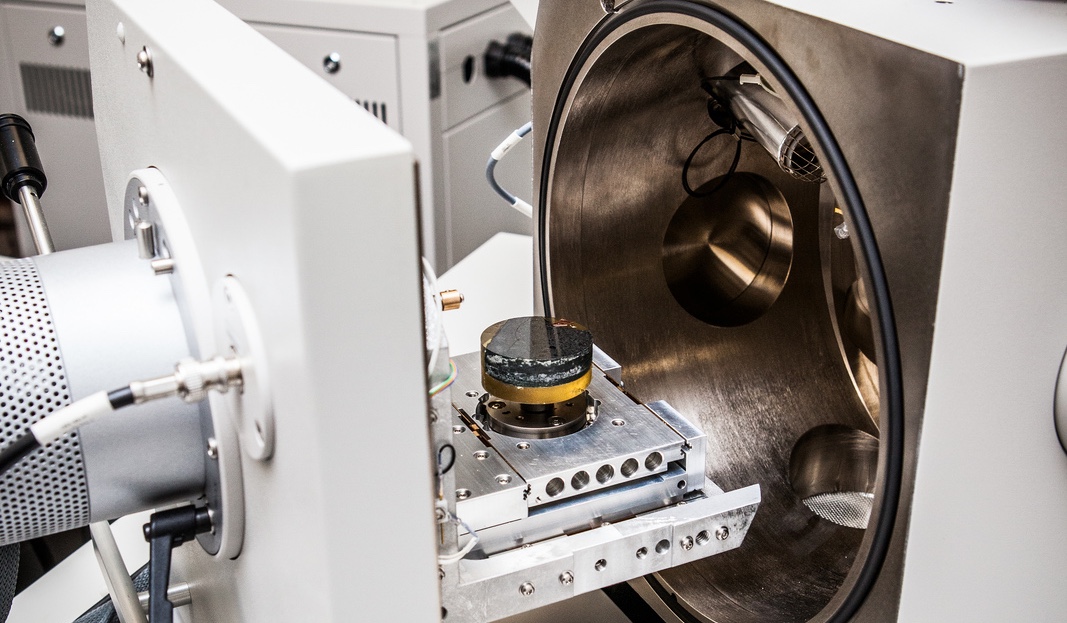
A close up view of a sample inside a SEM (Scanning Electron Microscope).

A close up view of a sample inside a SEM (Scanning Electron Microscope).

What are your average work hours?

A normal, professional work week—40 hours/week. More if there are deadlines or traveling.

What personal tips and shortcuts have made your job easier?

Spreadsheets are essential for project management to keep track of project tasks or budgets, as well as from a technical stand point to understand chemical analyses and to calculate, graph, and import data.

Another tip is sharing data; part of being a scientist is to not replicate work that has been done or is being conducted. It is then helpful to publish the research or put data onto a database for distribution. We use the Energy Data eXchange (EDX) at NETL.

What do you do differently from your coworkers or peers in the same profession? What do they do instead?

As I said above, I spend more time in the experimental and petrographic laboratory and interpreting the results. I spend less time in the field than my peers, for example, collecting samples, mapping regions, or being on an oil rig. In addition, several of my peers primary focus use applied geophysical modeling or geographic information system (GIS) to capture, store, manage, analyze spatial data. Furthermore, many geologists are in academia, which includes research and teaching.

What’s the worst part of the job and how do you deal with it?

Personally, the worst part of the job is the amount of technical writing required. You undergo a lot of revisions for technical reports and peer reviewed journal articles. I’m a descriptive writer, so I’ve had to learn to reign it in and learn from mistakes.

What’s the most enjoyable part of the job?

The most enjoyable part of the job is when I’m using the microscopes. You get to see details down to a micrometer scale, something the naked eye can’t see. It’s an unseen world that I get to be a part of. It can also be like a micro-treasure hunt to find changes in mineral phases or microorganisms.

What kind of money can one expect to make at your job?

Salary can range depending on your education level and where you are employed. The bottom 10% make $46k whereas the median salary for geologist in all sectors is $84k.

How do you move up in your field?

A geologist can advance their career by getting additional certifications (e.g. registered geologist) or pursue higher education. Specifically where I work, advancement of job positions [would be] into project management, such as technical team coordinator, team lead, or division director.

What advice would you give to those aspiring to join your profession?

The best advice I can give to an aspiring geologist is to never stop learning. Take as many science courses so can to figure out what field interests you, such as geology, engineering, physics, or mathematics. In addition, geography, computer science, environmental science, GIS, and drawing/art courses are also very helpful. Geology is a wide field with many hot topics to explore, including environmental or climate change, energy, geological hazards or mitigation, and mining. Examples of [jobs] in the field are engineering geologist, geochemist, geophysicist, hydrologist, mudlogger, wellsite geologist, environmental consultant, exploration geologist in academia, the oil, gas, petroleum sector, engineering or construction firms, government, museums, and private industry.

The Lego set that Verba designed. There is a figure using a SEM in the lab and another collecting samples of purple crystals in the field.

Vote for her LEGO set here: https://ideas.lego.com/projects/93813

I created the Research Geology LEGO set [because] I am also an active participant in Science, Technology, Engineering, and Mathematic (STEM) education by being involved in high school career fairs and science activities. I feel that it is important to find fun ways to encourage children, of both genders, to use critical thinking skills. As an adult, I still play with LEGO, a cobblestone of my childhood. So I created a LEGO set called Research Geology, which highlights my career as a research geologist both in the field and in the laboratory. While I included both genders in my set, I wanted to highlight that women can be scientists too. I strongly believe that we can impact young minds and pave the way for future scientists. We can change the world, one geek at a time.