Images

Joplin Field Trip 2016

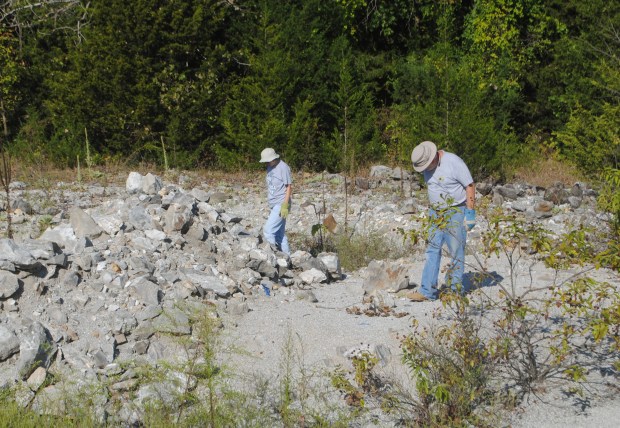
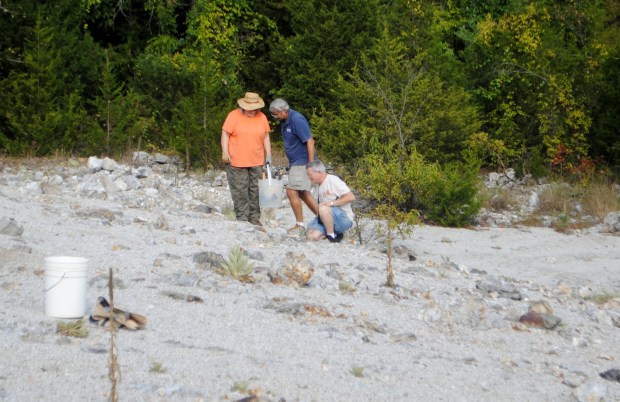
people looking at rocks collecting rocks joplin

Mardell, Kerry, and Roy. Photo by Molly Stinemetz.

people looking at rocks collecting rocks joplin

Janice and Mike looking for rocks. Photo by Molly Stinemetz.

people giving charitable donation shaking hands

Bruce Stinemetz presenting a donation from the Friends of Mineralogy to Brad Belk, Director of the Joplin Museum Complex. Photo by Molly Stinemetz.

Some rockhounds went on a field trip to Joplin, MO in September 2016. They looked for rocks and went to the Joplin Museum Complex, where they gave the museum a donation from the Friends of Mineralogy, which is a national non-profit group of people who love studying minerals. Many of our rockhounds are members of multiple clubs, including this one. The Friends of Mineralogy make donations such as this one because they are a 501(c)(3) organization and because the Joplin museum is really cool and deserves it.

How Amethyst Cathedrals are Formed

purple amethyst cathedral in a museum with other minerals

Amethyst cathedral at the Sutton Museum. Photo by Stephanie Reed

Article by Dr. Bill Cordua, University of Wisconsin-River Falls

Have you ever been to a show and seen enormous amethyst geodes or crystals 3-5 feet or more in height? The tubular geodes are lined with deep purple gemmy amethyst crystals. How do such wonders form?

These excellent geodes come from a region along the Brazil-Uruguay border. The genesis of deposits on the Brazil side of the border has recently been extensively researched by an international team of geochemists lead by H. Albert Gilg of Techniche University Munchen in Germany (Gilg, et. al., 2003). The geodes are mined from several lava flows belonging to the Parana Continental Flood Basalt Province. This was one of the largest outpourings of basalt lava known. An estimated 800,000 cubic kilometers of lava extruded over an 11 million year time span. For comparison, this would be enough to cover Minnesota with a pile of basalt lava over 2 miles high. The lava outburst occurred as part of the opening of the South Atlantic Ocean during Cretaceous time about 130 million years ago. Of all these flows, however, only a few are known to host amethyst cathedral geodes.

Gilg et al. proposed a 2-stage model for their formation. In the first stage the large hollows form. This was caused as volcanic gases were released from certain lavas as they cooled. Not every lava has enough dissolved gas to form such big openings. As gas bubbles emerged from the congealing lava (much as bubbles emerge when beer or soda pop is poured) they coalesced as they rose. The lava was cooling fast too, and soon became so thick and sticky that bubbles quite rising and were trapped. The bulbous to tubular shapes thus point towards the top of the flow, a fact easily seen when the geodes are in place in the mines. These cavities, though, were empty of crystals.

The second stage was the formation of the amethyst, plus celadonite, calcite and gypsum fillings. An important clue to this event is the presence of small gas and liquid bubbles (called fluid inclusions) trapped within these minerals. These are samples of the mineral-forming liquids caught as the crystals grew. Fluid inclusions are treasure troves of information when studied with sophisticated instruments. Analyses of the fluid inclusions in the amethyst, calcite and gypsum show them to be filled with slightly salty water. This water had a temperature of no more than 100 degrees C, and possible less than 50 degrees C, during mineral formation. These cannot be fluids related to the magma that formed the lavas.

What was the source of these fluids? An amazing story unfolds from the radiometric dating of the minerals. The basalts formed about 130 million years ago, but the green celadonite, which makes up the rinds of the geodes, formed about 70 million years ago. For 60 million years these enormous cavities sat empty of crystals. Trace element data from the fluid inclusions gives another important clue to the source of the mineral-forming fluid. Below the lavas is a large aquifer (the Botucatu aquifer) filled with ground water that closely resembles the fluid inclusion liquids. Uplift and tilting of the area about 70 million years ago would force water out of the aquifer into the porous areas of the overlying lava. In the lava flow these waters would have found volcanic glass. Glass breaks down over geologic time and makes silica and other chemicals available in a form that is readily soluble in water soaking through the rocks. The water carried these chemicals into the cavities, where the amethyst and other minerals grew due to cooling and pressure release.

The special combination of geologic circumstances, unfolding over millions of years, is not often duplicated. Understanding the process gives geologist tools to prospect more efficiently for these wonders.

Reference:
Gilg, H. et. al, 2003, “Genesis of amethyst geodes in basaltic rocks of the Serra Geral Formation (Ametista do Sul, Rio Grande do Sul, Brazil): a fluid inclusion, REE, oxygen, carbon, and Sr isotope study on basalt, quartz and calcite” Mineralium Deposita vol. 38, p. 1009-1025.

The Glacial Drifter 08/2011, The Gemrock 06/2015
Geode Cake

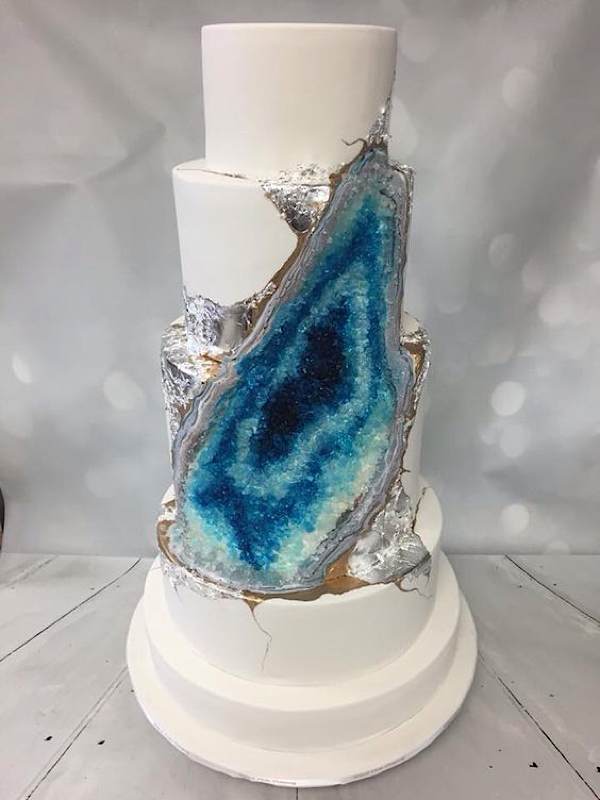
a white layered cake with a blue candy geode decoration

Cake by Whisk Cake Company, http://www.whiskcakes.com

A talented baker made this geode layer cake with fondant for the layers and a rock candy geode surrounded by gold and silver leaf. I am very impressed with the banding in the geode. It looks very tasty. This cake was recently featured on Cake Wrecks in their Sunday Sweets section, which is a day of beautiful cakes to contrast with the awful cakes on other days. There are other geode and rock-related cakes including a malachite cake posted that day, so be sure to go to the Cake Wrecks post “Oh Em Geode” and see the rest.

Labradorite

Labradorite has become a popular gemstone because of the unique iridescent play of color that many specimens exhibit.  Labradorite is a feldspar mineral of the plagioclase series that is most often found in mafic igneous rocks such as basalt, gabbro and norite.  Some specimens of labradorite exhibit a Schiller effect, which is a strong play of iridescent blue, green, red, orange, and yellow colors as shown in the photographs above. The Schiller effect is also seen in fire agate and mother of pearl. Labradorite is so well known for these spectacular displays of color that the phenomenon is known as “labradorescence.” Specimens with the highest quality labradorescence are often selected for use as gemstones. Labradorescence is not a display of colors reflected from the surface of a specimen. Instead, light enters the stone, strikes a twinning surface within the stone, and reflects from it. The color seen by the observer is the color of light reflected from that twinning surface. Different twinning surfaces within the stone reflect different colors of light. Light reflecting from different twinning surfaces in various parts of the stone can give the stone a multi-colored appearance.

Source: http://geology.com/gemstones/labradorite/

Selenite Stories

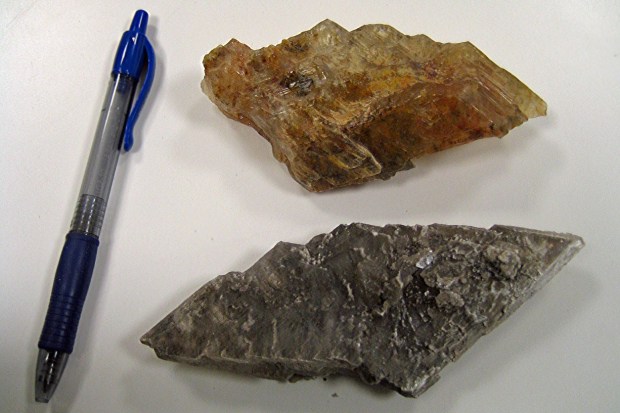
Gray selenite crystal and orange selenite crystal, both about the size of a ballpoint pen.

Photo by Stephanie Reed

Selenite is a type of gypsum that has a flat reflective surface, usually gray, clear, white, or amber. Red is an unusual color for selenite, but they do exist. It is very soft and can be scratched by a fingernail (2 on the Mohs scale). At our February meeting, two of the door prizes were these selenite crystals found by President David Reed. The amber one is from Lake Kanopolis in Kansas. The gray one is from Lake Wilson, which is also in Kansas. David went to Lake Wilson and put a small crystal in the mud. He returned 3 years later and found the large gray crystal.

One time David and Stephanie went to Kansas and found several selenite crystals somewhere near the dam at Lake Wilson. They were gray like this one pictured, but much smaller. On the April field trip to Marquette, some club members also found selenite crystals.

Spring Forward to the Show

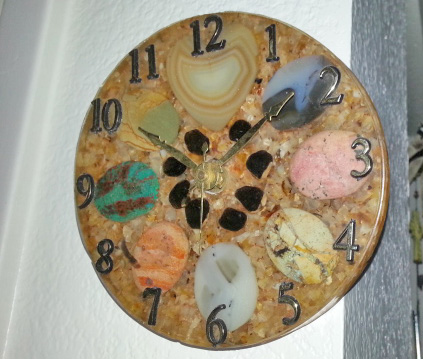
mineral clock with agates and apache tears

Photo by Stephanie Reed

We interrupt the Spring Gem and Mineral Show to remind you to set your clock forward one hour tonight for Daylight Savings Time.

This clock is from the collection of David Reed. It contains agates, Apache tears (obsidian), a craft store clock kit, and lots of resin. It looks pretty good with his other rock clock.

Pyrope Garnet

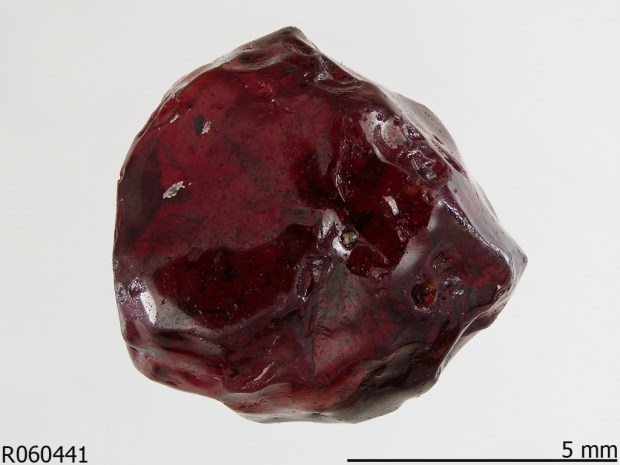
This is a special type of garnet called pyrope garnet. The name comes from the Greek pyro, meaning fire. Pyrope and other members of the aluminum part of the garnet group have a higher specific gravity and hardness, and are usually red. Calcium garnets like the previously mentioned andradite and uvarovite are the ones that are usually green and have a lower hardness and specific gravity.

Pyrope garnet is difficult to distinguish from almandine, but pyrope usually has fewer flaws and inclusions. However, garnet jewelry is usually almandine garnet because almandine is much more common and inexpensive.

If you would like some pyrope garnet it can be found nearby in Kansas, all around the Nemaha Uplift (or Nemaha Ridge), which is in the area between Salina and Manhattan, and extending south into Oklahoma. Basically, garnets are found anywhere near previous volcanic activity. The one pictured is from Apache County, Arizona. They are also found in Africa and other places. For lots and lots of information about this particular specimen, see its page on the RRUFF here.

Composita

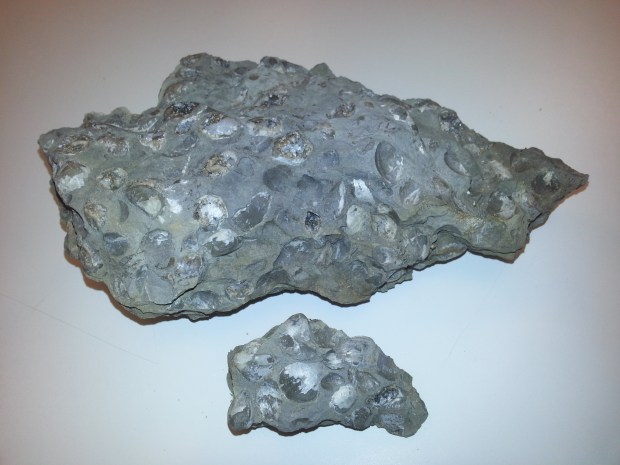
Lots of Composita shell fossils found in Kansas City

Photo by Stephanie Reed

If you came to our January meeting, you will know that we are now offering door prizes just like at IGAMS. All my spying on IGAMS meetings is proving to be very helpful! January’s door prize was part of Kansas City’s Composita layer. Composita is a genus of extinct brachiopods that were abundant during the Pennsylvanian era. Brachiopods are bottom-dwelling marine organisms that have two shells[1] and a little fleshy “foot” called a pedicle. In a fossil brachiopod, you can see the hole where the pedicle sticks out of the shell, which is called the pedicle valve. In the upper part of the Winterset Limestone in Kansas City, there is a zone consisting almost entirely of Composita shells. See Chapter 11 of Dr. Gentile’s book for more information. Some of the shells in this specimen even had crystals inside. It was collected by David Reed somewhere in the Kansas City area, but he’s not telling exactly where.

[1]Brachiopods have two shells, but they are not bivalves (an easy mistake to make). Bivalves are a class of mollusks, like clams, and do not have pedicles. Bivalves are symmetrical, and brachiopods are not. In fact, the bivalves may have caused the extinction of the brachiopods due to competition for food and living space.

A Great Geology Book

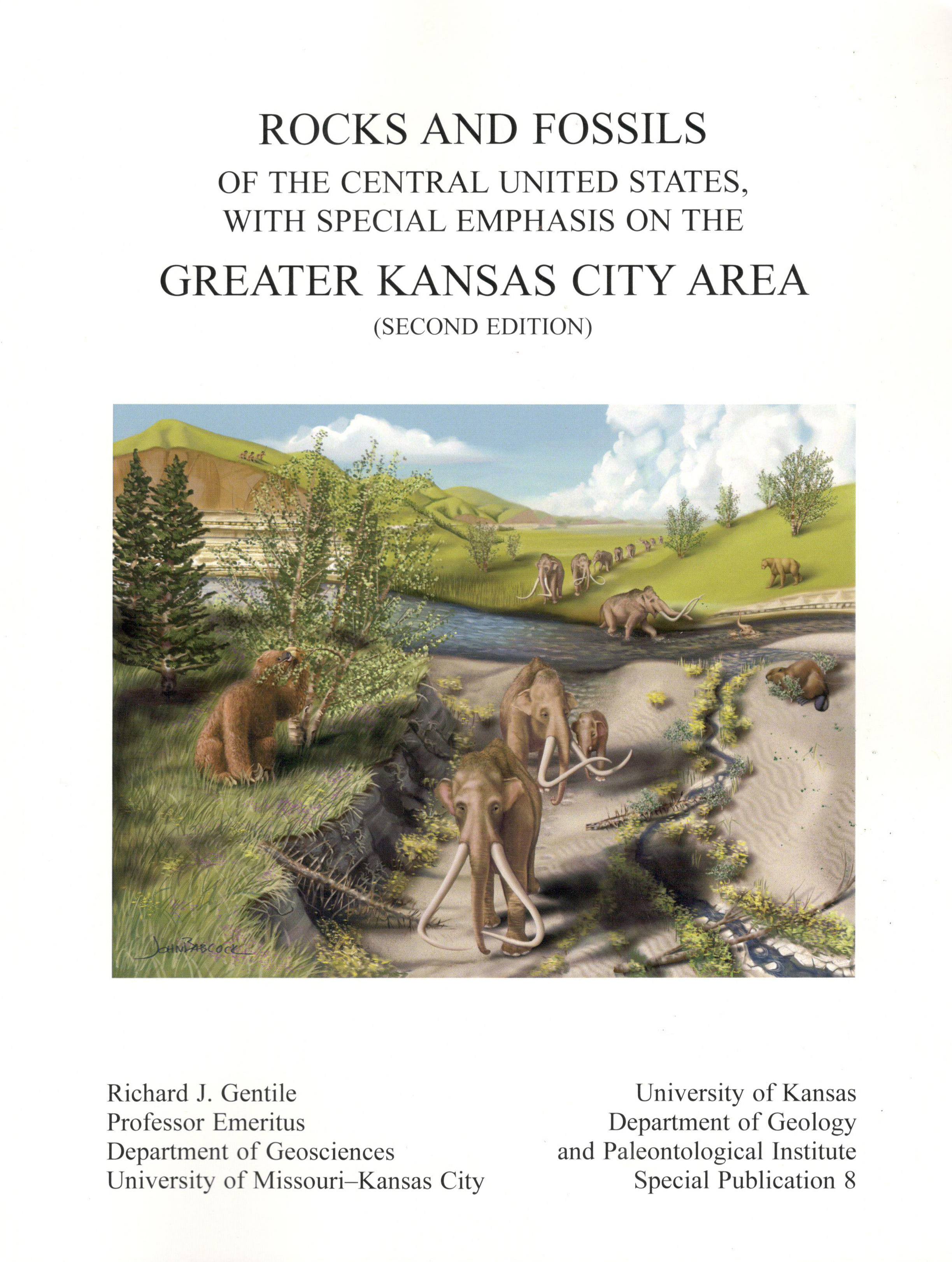
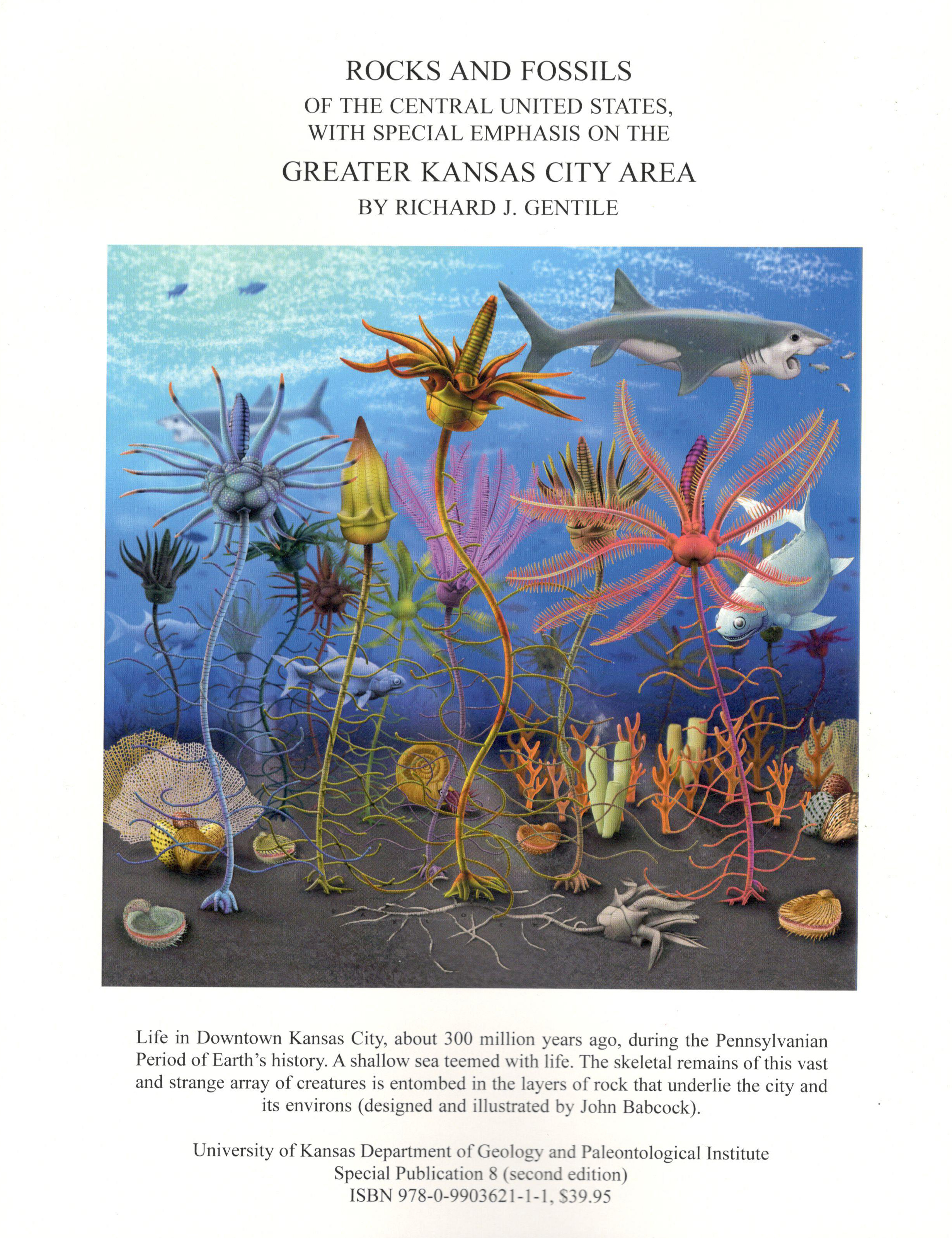
Rocks and Fossils of the Central United States with Special Emphasis on the Greater Kansas City Area by Richard Gentile

The front cover of Richard Gentile's book, Rocks and Fossils of the Central United States with Special Emphasis on the Greater Kansas City Area

Front cover

The back cover of Richard Gentile's book, Rocks and Fossils of the Central United States with Special Emphasis on the Greater Kansas City Area

Back cover

Review by David Reed:

This book is great! It has beautiful pictures of the fossils that can be found in Kansas City and clear stratographic sections explaining the geology of the area. It also shows locations for picking up the fossils. Everything you might wish to know about Kansas City is in this book. Well worth the money and you can ONLY get it at UMKC (Amazon doesn’t have it). We purchased one when we visited the Sutton Museum.

Anthracite

Q: What makes rockhounds different from non-rockhounds?

A: They are happy to receive coal for Christmas.

Rockhounds love coal, and they love anthracite even more. Anthracite is a type of coal. It is very hard and burns slowly and cleanly due to its high carbon content and few impurities. It is rarer than bituminous coal (the soft, most common form of coal); in fact, less than 2% of the coal in the United States is anthracite. Also unlike bituminous coal, anthracite won’t leave soot on your fingers when you touch it.

There are four types of coal in all. The last two we haven’t covered yet are lignite coal and subbituminous coal, which have the lowest carbon content and are even softer then bituminous coal. Anthracite is the hardest and has the highest carbon content. Most of the coal in the United States is found in Colorado and Illinois, and is used primarily for making electricity and coke (coke is used by foundries to make iron and steel).