Rocks

Banded Agates

Agates are a variegated type of chalcedony (a type of quartz) that are made of microcrystalline silicon dioxide crystals formed in distinct bands. The name comes from the Achetes River in Sicily, where agates were first found. Agates are often cut into slabs, or agate pebbles are polished in rock tumblers or made into pretty striped beads. Being a semi-precious gemstone, they polish well and can be made into a lot of things.

Five oval-shaped polished tumbled banded agate rocks with differing shades of brown and white stripes.

Banded agate pebbles that have been tumbled. Photo from: http://www.healingcrystals.com/Tumbled_Banded_Agate_-_Tumbled_Stones.html

Banded agates are the traditional, “default” type of agate that you always see in museum gift shops or made into coasters and suncatchers. The colored bands are very distinctive. Since agates are porous, it is very easy to dye them, so you will frequently see agates dyed unnatural colors like bright blue, violet, or hot pink. Not that there’s anything wrong with that. Decide for yourself whether you are willing to buy an agate if it has been dyed, and then be aware that the natural colors of agate are black, white, yellow, gray, brown, red, pale blue, and pale pink. One final tip: If you want agate slab coasters, you’ll pay way too much if you buy them from a home decorating store like in the link. Just get some agate slabs at an upcoming gem show and glue some cork on the back.

A set of six circular banded agate coasters, in dark blue, purple, hot pink, orange, light blue, and brown.  The concentric circles formed by the bands are very pretty.

Banded agates that have been made into cute coasters.  The orange one and the brown one could be natural but the others are definitely dyed. Photo from: http://www.michaelcfina.com/tableware/bar-accessories/rablabs-pedra-coasters-AMRABLPECO.html

Spessartine

You may remember our earlier post about uvarovite, the green garnet.  Spessartine is another garnet group mineral.  Notice how similar the crystals look, except for spessartine being reddish orange (and a bit of yellow in there, too) and uvarovite being green.  It is named after where it was first found: the German city Spessart, in the state of Bavaria.  The specimen pictured was found in the Broken Hill district in New South Wales, Australia.  It can also be found in Madagascar, China, Myanmar, India, Afghanistan, Israel, and parts of the United States such as Maine and Colorado.  Look for it in granite pegmatite and also sometimes in metamorphic phyllites.

If you liked these posts, you may wish to research the other garnet group minerals: almandine (purplish-red to orangish-red), andradite (can be black, green, or yellow-green), grossularite (brown to yellow), pyrope (very dark red to black), and tsavorite (light to dark green).

Uvarovite

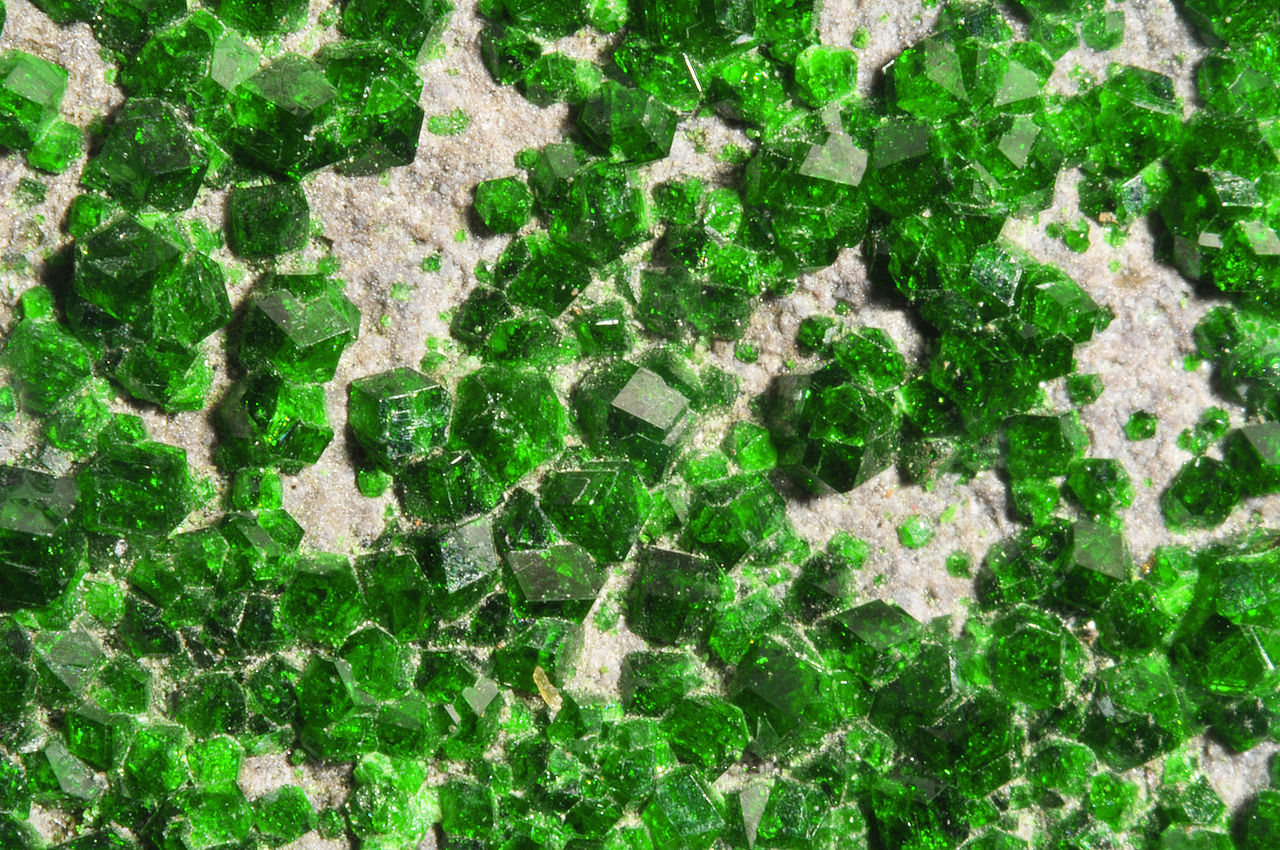
Uvarovite is a garnet group mineral, meaning that it’s structurally and compositionally similar to garnets, but unlike garnets, it is green. Uvarovite is named after Count Sergei Semenovitch Uvarov, a Russian statesman who was also quite the rockhound. It’s usually found in Russia, Spain, and Canada.  The photo above is an extreme close-up, and may be misleading.  Uvarovite crystals are usually about 2 mm long, so in “real life” it looks more like a plate of drusy quartz.  Here’s how it looks from a bit farther away:

A plate of tiny green sparkly crystals of uvarovite.

Photo by Rob Lavinsky, retrieved from Mindat http://www.mindat.org/photo-118217.html

This specimen is from the Saranovskii Mine in Russia, and I think it’s quite pretty, don’t you?

Chondrodite on Magnetite

A shiny black chunk of pyramidal magnetite with glittering red crystals of chondrodite on top

Photo by Rob Lavinsky, retrieved from Mindat at http://www.mindat.org/photo-37952.html

A shiny black chunk of pyramidal magnetite with glittering red crystals of chondrodite on top. It was found in the Tilly Foster Iron Mine in New York. Since it measures only 2.8 x 2.6 x 2.1 cm, if you’re on a desktop or tablet, you’re viewing it larger than actual size.

Granite

Did you know granite is not a mineral?  Granite can’t be called a mineral because it is a mixture of many other minerals.  Specifically, granite is a felsic (contains a lot of feldspar and quartz) intrusive (used to be liquid underground and was pushed up) igneous rock (made from magma or lava that has cooled and solidified) with at least 20% quartz and up to 65% alkali feldspar by volume.  Sometimes it contains plagioclase feldspar, muscovite, biotite, and hornblende-type amphiboles as well.  Different ratios of all these minerals in the mixture are what create all of the different colors and varieties of granite.  Phew!  That was a lot of definitions.  If you need me, I’m going to drive by the granite store in Grandview.  They leave their big slabs outside so you can look at them at any time of day.  I guess granite slabs are too heavy to steal.

Mozarkite

The Mozarkite Society of Lincoln, MO is having their annual rock show right now, from September 19-21. There is FREE admission! It is at the Lincoln City Park, Shelter House, behind Casey’s. Hours: Fri 9-5, Sat 9-4, Sun 9-4. Go to www.mozarkite.com for more information.

Mozarkite is a variety of quartz that comes in many colors including red, pink, purple, blue, and white, usually in pretty swirls.  The name comes from Missouri and Ozarks, which is where mozarkite is often found.  It is considered a semiprecious stone because it has a hardness of 7.5-7.75 on the Mohs scale, making it hard enough to be polished and made into jewelry.  Mozarkite has been Missouri’s state rock ever since 1967.

Purple and blue mozarkite in an irregularly shaped rock and two polished green and purple mozarkite cabochons

Photos from the Mozarkite Society of Lincoln. http://www.mozarkite.com/samples.htm