rocks

Most of the specimens featured here, unless they are fossils

Fire Agate

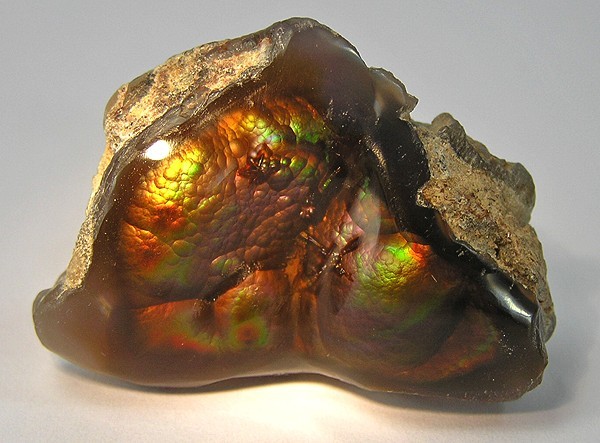
A triangular brown stone with the front face cut off and polished revealing iridescent shimmering red, orange, yellow, and a little bit of green colors inside.

Photo of a polished fire agate found in Aguascalientes, Mexico by Rob Lavinsky/irocks.com retrieved from http://www.mindat.org/photo-180670.html

Fire agates contain iridescent (rainbow) colors that resemble fire.  The iridescence comes from the diffraction of light between the fire agate’s alternating layers of silica and iron oxide.  This is called the Schiller effect.  You can also see the Schiller effect in labradorite and mother-of-pearl (hmmm, could there be a post about labradorite coming soon?).  It’s difficult to photograph iridescence, so any photos you see are probably even more beautiful in person.  Fire agates are rare, but may be found in Arizona, northern Mexico, and other parts of the Southwest.  Like other agates, they rate 6.5-7 on the Mohs scale and are gorgeous when polished.
Dendritic Agate

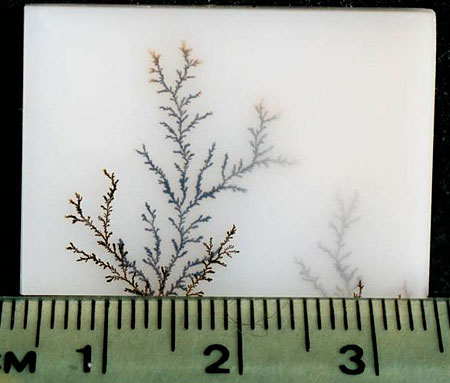
Dendritic agate has inclusions that look like thin, two-dimensional tree-like growths.  They are usually black or dark brown, especially if they are found in Montana.  Often dendrites form, between flat “waterline” bands of agate.  Dendrites may also occur in limestone, talc, sandstone, beryl, corundum, and other minerals.  Dendritic and moss agates both look amazing as cabochons, because they look like little pressed flowers or landscape scenes.  The specimen pictured is from Del Norte, Colorado.
Source: The Gemrock, 7/2014

Sagenitic Agate

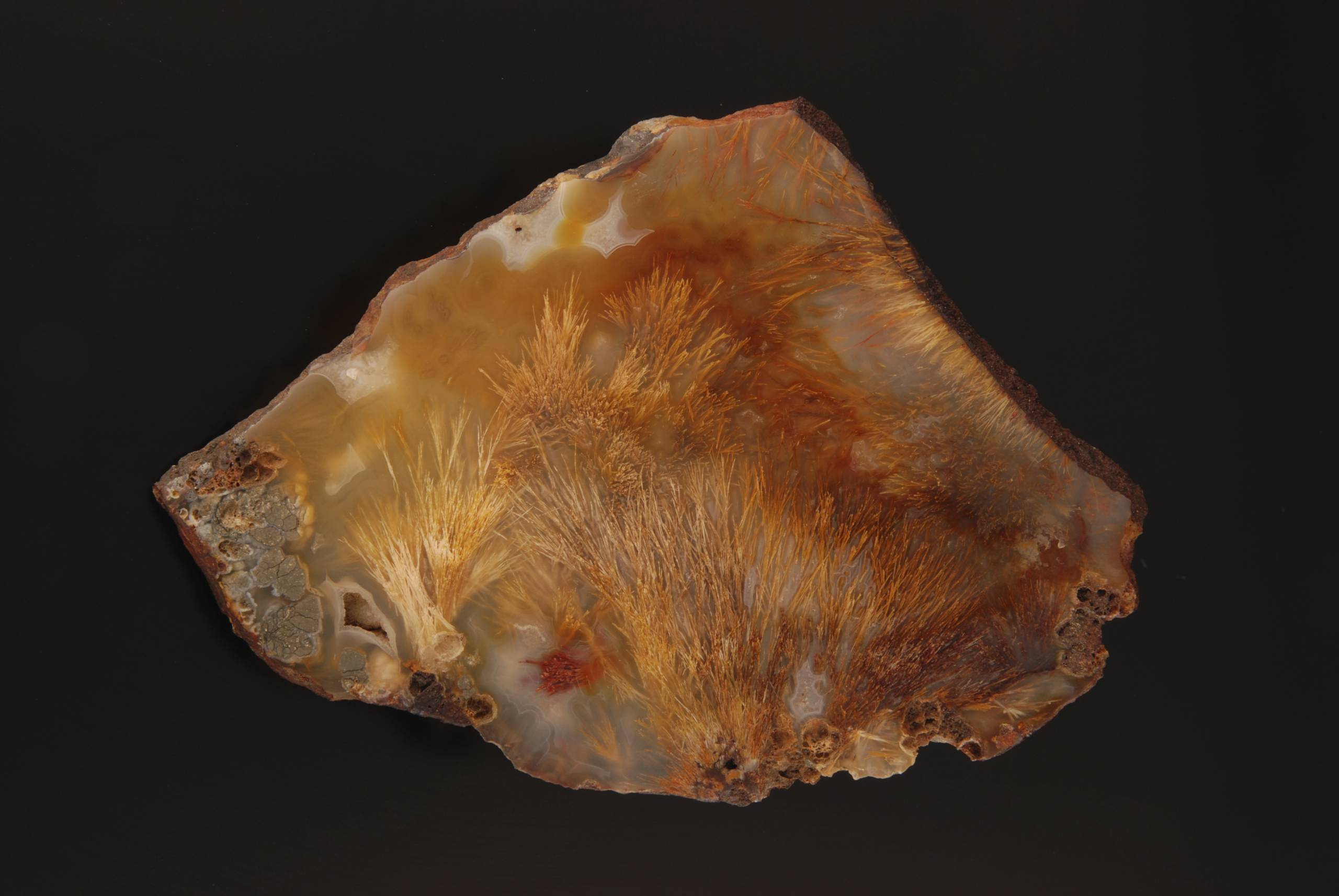
Sagenitic agate is any agate having acicular or needle-like mineral growths inside.  These hair-like filaments are often arranged in fans or starbursts.  The inclusions come in a wide array of colors.  Sagenite has been found in over 250 different agate deposits worldwide, a little in most agate fields, probably less that 5% of the available agate in most fields.  This agate is from California and contains mostly yellow sagenite but also a few plumes; can you spot them?

Source: The Gemrock, 7/2014

Update: It looks like somebody at IGAMS (and the CMS Tumbler, The Clackamette Gem, and The Glacial Drifter, all of whom were listed as sources) might be a fan of Pat McMahan’s website Agates With Inclusions, as the text from their article on agates that I read is very similar to this article on sagenite and plume on his website.  So, thank you for the inspiration, Mr. McMahan!

Plume Agates

Light red translucent agate with red and orange puffy plumes appearing to float inside it.

From the collection of Don Volkman, photographed by Karl Volkman. http://www.mindat.org/photo-152268.html

Plume agates have fluffy inclusions which often appear to be soft and have depth.  Sometimes, plume agate inclusions resemble feathers, plants, or flowers.  Possible colors include red, orange, yellow, pink, and white.  Plume agates are most commonly found in Oregon’s Graveyard Point, Idaho, Colorado, West Texas, and Mexico.  The agate pictured is from Texas.

Source: The Gemrock, 7/2014
From the collection of Don Volkman, photographed by Karl Volkman. http://www.mindat.org/photo-152268.html

Moss Agate

The name moss agate is a bit of a misnomer, because they contain no moss. Moss agates have green inclusions that look like moss or seaweed. The green color comes from manganese oxide or other green minerals. It is the most common type of agate inclusion. Moss agates are most commonly found in Montana and Wyoming.  The one pictured is from Maury Mountain, Oregon.
Source: The Gemrock (IGAMS newsletter), 7/2014

Crazy Lace Agate

Today’s agate is the Crazy Lace Agate. The complicated layers look like lace, hence the name. Since they are found in Mexico, sometimes they are called Mexican agates. It is not known exactly how they form, but perhaps they were disturbed somehow during silicification, creating the crooked layers.  You may recognize this photo if you visit our Google+ page; it’s one of my favorite mineral photos.

Banded Agates

Agates are a variegated type of chalcedony (a type of quartz) that are made of microcrystalline silicon dioxide crystals formed in distinct bands. The name comes from the Achetes River in Sicily, where agates were first found. Agates are often cut into slabs, or agate pebbles are polished in rock tumblers or made into pretty striped beads. Being a semi-precious gemstone, they polish well and can be made into a lot of things.

Five oval-shaped polished tumbled banded agate rocks with differing shades of brown and white stripes.

Banded agate pebbles that have been tumbled. Photo from: http://www.healingcrystals.com/Tumbled_Banded_Agate_-_Tumbled_Stones.html

Banded agates are the traditional, “default” type of agate that you always see in museum gift shops or made into coasters and suncatchers. The colored bands are very distinctive. Since agates are porous, it is very easy to dye them, so you will frequently see agates dyed unnatural colors like bright blue, violet, or hot pink. Not that there’s anything wrong with that. Decide for yourself whether you are willing to buy an agate if it has been dyed, and then be aware that the natural colors of agate are black, white, yellow, gray, brown, red, pale blue, and pale pink. One final tip: If you want agate slab coasters, you’ll pay way too much if you buy them from a home decorating store like in the link. Just get some agate slabs at an upcoming gem show and glue some cork on the back.

A set of six circular banded agate coasters, in dark blue, purple, hot pink, orange, light blue, and brown.  The concentric circles formed by the bands are very pretty.

Banded agates that have been made into cute coasters.  The orange one and the brown one could be natural but the others are definitely dyed. Photo from: http://www.michaelcfina.com/tableware/bar-accessories/rablabs-pedra-coasters-AMRABLPECO.html

Spessartine

You may remember our earlier post about uvarovite, the green garnet.  Spessartine is another garnet group mineral.  Notice how similar the crystals look, except for spessartine being reddish orange (and a bit of yellow in there, too) and uvarovite being green.  It is named after where it was first found: the German city Spessart, in the state of Bavaria.  The specimen pictured was found in the Broken Hill district in New South Wales, Australia.  It can also be found in Madagascar, China, Myanmar, India, Afghanistan, Israel, and parts of the United States such as Maine and Colorado.  Look for it in granite pegmatite and also sometimes in metamorphic phyllites.

If you liked these posts, you may wish to research the other garnet group minerals: almandine (purplish-red to orangish-red), andradite (can be black, green, or yellow-green), grossularite (brown to yellow), pyrope (very dark red to black), and tsavorite (light to dark green).